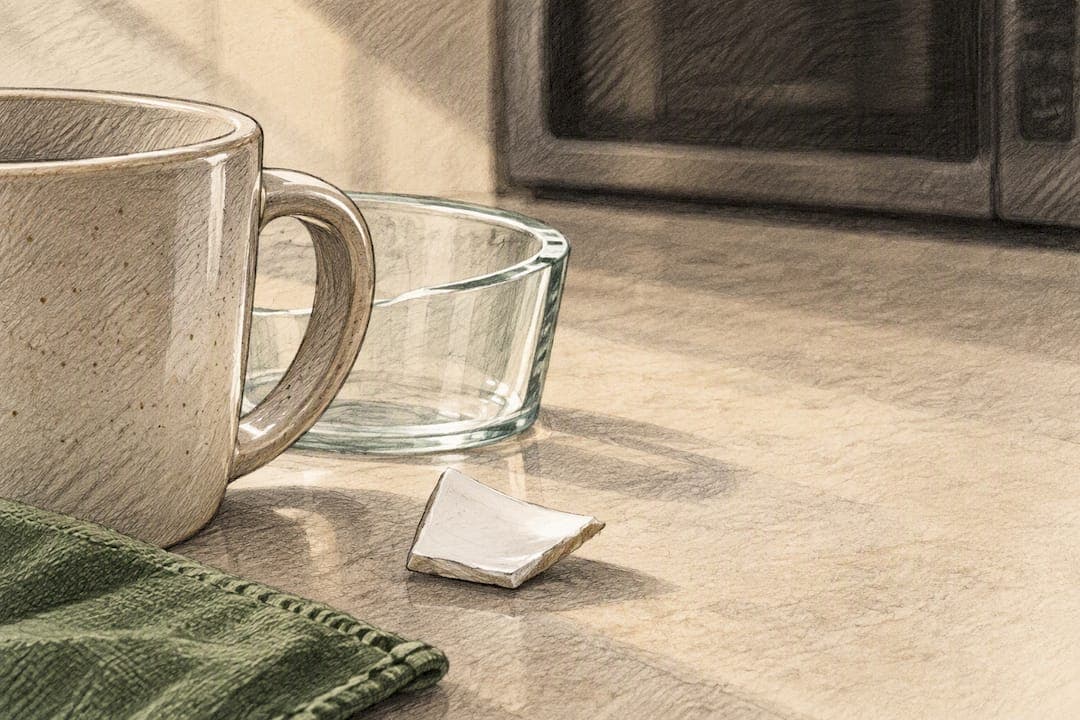
Most labeled ceramic, porcelain, vitrified stoneware and heatproof glass mugs are microwave safe, as long as they carry no metallic trim or paint. Metal, enamelware and unmarked plastics are not safe choices. If a mug has no label, run the one-minute water test described below before you trust it for daily reheating.
TL;DR:
- Only ceramic, porcelain, vitrified stoneware, and heatproof glass mugs with no metallic trim or paint are reliably microwave safe without testing.
- Labeled "microwave safe" mugs or those passing a water test—staying cool when the water inside is hot—are the safest options.
- Metal, enamelware, unmarked plastics, and heavily crazed or chipped pottery pose fire, leaching, or cracking risks and should be avoided entirely.
- The water test involves microwaving water-filled mugs for one minute and checking if the mug stays cool, as unsafe materials will heat unevenly or become hot.
- Protect vintage, handmade, or imported pottery with lead test swabs to prevent lead leaching, especially in unmarked or poorly fired pieces.
Table of Contents
- Buyer checklist: what to look for on the label and product page
- How common mug materials behave in the microwave
- How to check an unlabeled mug: step by step tests and red flags
- Mugs and materials you should never microwave
- Care tips to keep microwave-safe mugs safe longer
- Estimated price range for microwave-safe mugs
- Typical durability and warranty information
- Common brands or trusted manufacturers offering microwave-safe mugs
- How long it typically takes for different mugs to heat beverages in the microwave
- Sincerely Skye's approach to microwave-safe mugs for crafters
- Sincerely Skye's microwave-safe mug options and how to buy
- Sources
- FAQ
Buyer checklist: what to look for on the label and product page
Before you add a mug to your cart, scan the listing or the base of the mug itself for a few specific signals. A little label reading now saves you a cracked mug or a scorched microwave later.
- Look for an explicit "microwave safe" claim printed on the packaging, the product page or stamped into the base of the mug.
- Favor porcelain, stoneware and tempered glass over enamel, metal or unmarked plastic.
- Check the care instructions: a mug marked dishwasher safe often shares the same dense, well fired glaze that makes it microwave friendly too.
- Skip anything with luster finishes, metallic decals or vague handmade origin unless you plan to test it first.
- Pick a size and handle shape that stays cool enough to grip once the drink inside is hot, since a mug fresh out of the microwave can be deceptively warm at the rim. The right mug size also affects how evenly a drink heats.
According to USDA/FSIS guidance, only cookware explicitly labeled microwave safe should go into the microwave, and anything with metal or metallic paint should stay out entirely.
Pro Tip: Keep a sticky note or masking tape label on the bottom of any mug you have already tested and confirmed safe, especially in a shared kitchen.
How common mug materials behave in the microwave
Ceramic, porcelain and vitrified stoneware share a property that makes them good microwave candidates: they are dense, largely nonporous once properly fired, and they absorb very little microwave energy themselves. The microwave's energy passes through the material and heats the liquid instead, which is exactly what you want. Heatproof glass, like tempered borosilicate, behaves the same way and is why glass measuring cups and glass mugs are common in kitchens.
Metal is the opposite case. A microwave's energy reflects off metal rather than passing through it, and that reflection can concentrate into sparks, a phenomenon known as arcing. Consumer Reports explains that metal causes this arcing and fire risk, while glass, ceramics and stoneware are usually safe, though narrow necked bottles and overheating carry their own hazards.
That reflective behavior is exactly the problem with:
- Metallic glazes, gold or silver luster finishes and metallic decals, which act like tiny sheets of foil on the mug's surface.
- Enamelware, which looks ceramic on the outside but has a solid metal core underneath the coating, making it fundamentally incompatible with microwave ovens.
- Unlabeled plastics, foam cups and many disposable coffee cups, which can warp, melt or leach chemicals under microwave heat rather than staying inert.
- Old or improperly fired pottery, where a poorly formulated glaze can leach lead into food and drink, a separate risk from arcing but one that matters just as much for anything you drink from regularly.
Only cookware explicitly labeled microwave safe should be used, according to USDA/FSIS, a baseline rule that covers every material on this list, not just the obvious ones like metal.
The lead question deserves its own attention because it is invisible until tested. The FDA's guidance on lead glazed pottery notes that improperly fired or traditional pottery can leach lead, and the agency provides testing thresholds along with advice to avoid food use for any piece that fails a leach test. This risk shows up most often in vintage pieces, imported traditional pottery and some handmade items rather than in mass produced, food grade retail mugs.
For plastics specifically, the rule is narrower than many people assume. USDA/FSIS guidance on plastics warns against one time use containers and thin plastics in microwaves because of warping and chemical migration, so a plastic travel mug is only a safe bet when it carries its own microwave safe label, not simply because it looks sturdy.
How to check an unlabeled mug: step by step tests and red flags
When a mug has no label and no obvious documentation, a short test tells you more than guessing ever will.
- Fill the mug about halfway with water and microwave it for one minute on high.
- Touch the mug carefully right after: if it stays cool while the water inside is hot, the mug is likely microwave safe.
- If the mug itself is very hot or even too hot to hold, the material is absorbing microwave energy and should not go back in.
- For vintage, handmade or imported pottery, consider a lead test swab kit, sold at most hardware stores, before using the piece for food or drink.
- Check for visual red flags before you even reach for water: crazing (a network of fine surface cracks), chips, an unglazed foot ring, or any metallic paint.
- If you cannot verify the material or origin, reach out to the seller or maker directly and ask about the clay body, glaze and firing temperature.
The Clemson HGIC water test is the simplest version of this check: fill a dish with water, run the microwave for one minute, and compare how hot the water gets against how hot the dish itself gets. A cool dish and hot water is the signal you want.
If a mug starts smoking, sparking or gets alarmingly hot during any test, stop the microwave immediately, unplug it if it is safe to do so, and let everything cool before you touch it. Do not put that mug back in the microwave again.
Pro Tip: Run the water test on any inherited, thrifted or gifted mug before its first use, even if it looks like standard ceramic.

Mugs and materials you should never microwave
Some categories are not worth testing. Treat these as permanent no's rather than candidates for the water test.
- Any mug with metallic trim, gold or silver luster, or metallic decals, since the metal content risks arcing regardless of how thin it looks.
- Enamelware and travel mugs with a metal lining, because the metal core behaves the same way as a solid metal cup would.
- Disposable foam cups, unlabeled paper cups and thin plastics not marked microwave safe, all of which can warp or leach chemicals.
- Decorative pieces stamped "not for food use," along with heavily crazed or porous pottery that can harbor bacteria and absorb heat unevenly.
- Chipped or deeply cracked mugs, since trapped moisture in a crack can expand rapidly under heat and cause the mug to fail.
Enamelware's metal core is easy to miss because the surface finish looks just like ceramic, which is exactly why it causes so many accidental sparks in home kitchens.
Care tips to keep microwave-safe mugs safe longer
A mug that starts out microwave safe does not necessarily stay that way forever. Everyday habits either preserve the glaze that makes it safe or slowly wear it down.
- Avoid pulling a mug straight from the freezer or filling it with ice water and then microwaving it, since sudden temperature swings can cause thermal shock and cracking.
- Retire any mug once it develops chips, crazing or cracks rather than trying to reseal or patch it.
- Follow the maker's specific care notes for printed or sublimation coated mugs, since dishwasher cycles can wear these finishes faster than hand washing.
- Understand that repeated microwave use gradually stresses decals and coated surfaces, so a mug printed with a design may show fading before an uncoated one does.
- Store mugs so they are not stacked rim to rim or jostled against each other, which prevents the small chips that eventually turn into cracks.
A simple care routine built around gentle washing and careful storage does more for a mug's long term microwave safety than any single purchase decision.
Estimated price range for microwave-safe mugs
Standard ceramic and stoneware mugs from mainstream retailers tend to sit at the lower end of mug pricing, while hand-decorated or small batch pottery costs more because of the labor and glazing process involved. Heatproof glass mugs, particularly double walled styles, often land in a similar or slightly higher range because of the extra manufacturing step.
Price alone is not a safety signal. A budget mug with a properly fired, food grade glaze is just as microwave safe as an expensive one, and an expensive vintage or import piece can still fail a lead test. What actually predicts safety is the label, the glaze quality and, when in doubt, the water test, not the number on the price tag.
Personalized or custom printed mugs typically add a premium over plain versions because of the printing or sublimation process, though that premium reflects the decoration, not necessarily an upgrade in microwave performance. When you are choosing between a plain labeled mug and a decorated one at a higher price, treat the decoration as a style choice and confirm microwave safety separately through labeling or testing.
Typical durability and warranty information
Most retail ceramic and stoneware mugs are built for years of regular use, including repeated microwave cycles and dishwasher washes, provided the glaze stays intact and the piece has no chips or cracks. Warranty coverage on mugs varies widely by retailer and is often limited or nonexistent for a low cost item, so durability in practice depends more on how carefully you handle and store a mug than on any written guarantee.
Chips and hairline cracks are the main threats to a mug's working life. Once a glaze is broken, that spot becomes a weak point that can trap moisture, absorb stains and eventually fail under microwave heat, even if the rest of the mug is sound. Printed or sublimated mugs face an additional wear factor: the coating that carries the design can dull or fade faster than the ceramic body underneath, especially with frequent dishwasher cycles, according to guidance on sublimation mug durability.
Because of that, the most reliable way to judge a mug's expected lifespan is inspection over time rather than a warranty claim: check the glaze and rim periodically, and retire a mug at the first sign of a crack rather than waiting for a full break.

Common brands or trusted manufacturers offering microwave-safe mugs
A wide swath of mainstream tableware brands, from big box retail lines to specialty pottery studios, sell mugs explicitly labeled microwave safe, and that label is the detail to check regardless of brand name. Independent makers and small batch potters also produce microwave safe pieces when they use a properly vitrified stoneware or porcelain body and a food grade glaze fired to the right temperature, a standard pottery makers themselves point to as the practical benchmark for safety.
Coffee and kitchenware specialty retailers are another common source, often pairing mug sales with related brewing equipment that shares similar material considerations around heat retention and handling. Handmade and craft marketplaces round out the picture, though buyers should treat these listings the way they would treat any unlabeled mug: check for a stated microwave safe claim or plan to run the water test before regular use.
No single brand name guarantees microwave safety on its own. The label, the glaze and, for vintage or imported pieces, a lead test remains the deciding factors no matter who made the mug.
How long it typically takes for different mugs to heat beverages in the microwave
Heating time depends more on the drink's volume and starting temperature than on the mug material itself, since the mug is meant to absorb little of the microwave's energy in the first place. A full mug of refrigerated coffee or water generally takes longer to reach a hot drinking temperature than a half full mug of room temperature liquid, simply because there is more liquid mass to heat.
Wall thickness plays a secondary role. A thick stoneware mug can insulate the liquid slightly differently than a thin porcelain one, which is part of why heat retention varies by material and wall thickness, though the difference shows up more in how long a drink stays warm afterward than in how fast it heats initially.
Because microwave wattage varies by appliance, there is no single universal time that applies to every mug and every drink. The practical approach is to start with a short interval, check the temperature, and add time in small increments rather than guessing at a long single cycle, which also reduces the risk of overheating a liquid past a rolling boil.
Sincerely Skye's approach to microwave-safe mugs for crafters
When thinking about mugs for crafters, safety comes before the artwork. A design only matters if the mug underneath is properly labeled, fired at the right temperature, and glazed in a way that holds up to a microwave and a dishwasher without breaking down.
For crafters who decorate their own mugs, the coating matters as much as the base material. A sublimation or printed finish needs to be rated for both food contact and heat, and repeated microwave and dishwasher cycles will wear a poorly applied coating faster than a well fired one. Check your mug care routine and testing steps before you commit a design to daily use.
— Skye
Sincerely Skye's microwave-safe mug options and how to buy
You do not have to choose between a mug that looks good and one you can actually trust in the microwave. Our approach starts with the same standard we just walked through: clear labeling, a stable glaze and printing that holds up to regular reheating rather than fading after a few washes.
If you want a mug that fits both a morning routine and a crafting theme, the Red Checkered Heart Mug is a good starting point, and our broader shop carries additional mug and tumbler styles alongside apparel and accessories.
- Browse the shop for current mug and tumbler styles, including seasonal designs.
- Check the Sincerely Crafters collection for craft-themed pieces.
- Reach out through Handmade Customs if you want a personalized mug design.
For retailers or partners exploring similar labeling and safety practices in their own product lines, McLaren Tee Hub's guide to buying microwave safe mugs covers the same shopping checks from a general retail angle.
Visit the shop to see current mug options and place an order.
Sources
- Cooking with microwave ovens | USDA Food Safety and Inspection Service
- CPG Sec. 545.450 Pottery (Ceramics) — Lead contamination | FDA
- What’s safe to put in a microwave? | Consumer Reports
- Microwave food safety | Clemson HGIC
FAQ
What types of mugs are microwave safe?
Labeled ceramic, porcelain, vitrified stoneware and heatproof glass mugs are generally microwave safe as long as they have no metallic trim, according to USDA/FSIS guidance. Always confirm with a label or the one minute water test before regular use.
How do I check if a mug is microwave safe?
Look for an explicit microwave safe label on the mug or its packaging first. If there is none, run the one minute water test: heat the mug with water inside for one minute, and if the mug stays cool while the water is hot, it is likely safe.
Which microwavable mug is the best?
There is no single best mug, since safety depends on the label and glaze rather than a brand name. A well fired stoneware or porcelain mug marked microwave safe, such as options in the Sincerely Skye shop, is a reliable choice as long as it carries no metallic decoration.
Which mugs are not microwave safe?
Enamelware, metal mugs, and mugs with metallic trim, luster finishes or decals are never safe because the metal content causes arcing, per Consumer Reports. Unlabeled plastics, foam cups and cracked or heavily crazed pottery should also stay out of the microwave.
Can old or handmade pottery mugs leach lead when heated?
Improperly fired or traditional pottery can leach lead, according to FDA guidance, which is a particular concern for vintage or imported pieces. A lead test swab kit can confirm whether a specific mug is safe for food and drink use.