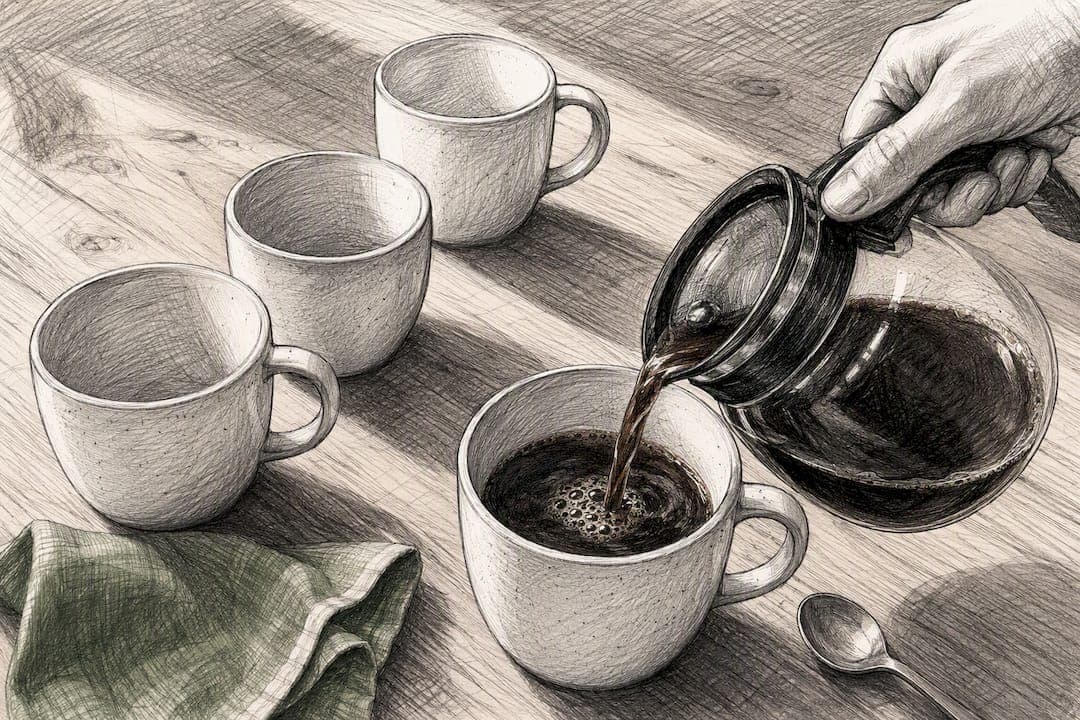
For most everyday drinking, a common mug size is around 11 to 12 oz. Choose a larger size, such as 15 to 16 oz, if you prefer fewer refills or frequently drink milk-based coffee. The trade-off is simple: smaller mugs keep drinks hotter longer, larger ones hold more but cool slower per sip. You can find both ranges commonly available, and the ounce-to-ml conversion math below will help you shop by the numbers instead of guessing.
TL;DR:
- Choosing a mug larger than 12 oz can lead to a quicker cooling rate, especially for black coffee or tea, unless you prefer fewer refills.
- Mug shape and material significantly influence heat retention and flavor experience, with narrow ceramic mugs and double-wall stainless mugs maintaining warmth longer.
- Consider handle comfort, drip tray clearance, and travel lid compatibility, particularly when selecting a mug for commuting or gift-giving purposes.
- Smaller, narrow mugs favor stronger flavors and slower cooling, making them ideal for black coffee or espresso, while larger or insulated mugs suit extended drinking sessions.
Table of Contents
- Mug Size Guide: A Quick Oz-to-Ml Chart
- 11 Oz vs 15 Oz Mugs: Which Fits Your Habits
- How Shape and Material Change the Way Your Drink Tastes and Cools
- How to Choose Mug Size by Where You'll Use It
- What to Check Before You Buy: A Fit and Safety Checklist
- Care, Cost, and What Size Actually Costs You Long-Term
- Why Sincerely Skye's Sizing Matches This Guide
- How Mug Sizes Became Standardized
- Mug Sizes Around the World Aren't the Same
- Why the Same Coffee Tastes Different in a Different-Sized Mug
- An Honest Take on Sizing Advice That Oversimplifies
- Get a Mug Sized Right for Your Routine
- Sources
Mug Size Guide: A Quick Oz-to-Ml Chart
Every mug size chart runs into the same problem: the number printed on the box is the brim-full capacity, not what you'll actually drink. Fill a "12 oz" mug to a sane level, leave room for cream, and you're often closer to 9 or 10 oz of usable liquid. That gap matters more than people think when they're comparing 11oz vs 15oz mugs side by side.
Here's how the standard coffee mug size range breaks down, with one ounce equal to roughly 29.57 ml, usually rounded to 30 for easy math:
- 8 oz (235 ml): espresso-adjacent pours, kids' hot chocolate, tea for someone who reheats often.
- 10 oz (295 ml): a compact everyday cup, good for strong black coffee you want to finish hot.
- 11 oz (325 ml): the most common mug size sold anywhere, and the default for a reason.
- 12 oz (355 ml): barely bigger than 11 oz but noticeably more forgiving with cream or foam.
- 15 oz (445 ml): the jump point for latte drinkers and slow sippers.
- 16 oz (475 ml): matches most drive-through "large," good for cold brew or oversized lattes.
- 20 oz (590 ml): closer to a soup bowl with a handle. Great for iced coffee, questionable for hot drinks that need to stay warm.
The beverage-to-size table that cafés actually use backs this up: espresso sits at 2 to 3 oz, cappuccino at 6 to 8 oz, latte at 12 to 16 oz, and cold brew at 16 to 20 oz. Match the drink to the size before you match the size to your cabinet.
11 Oz vs 15 Oz Mugs: Which Fits Your Habits
The 11 oz vs 15 oz mug choice concerns how quickly your drink cools and the comfort of holding the mug, rather than just volume.
An 11 oz mug has less surface area exposed to air, so black coffee or tea stays closer to drinking temperature for longer stretches. It's also lighter empty and full, which matters if you're using a two-finger handle instead of a full four-finger grip. A 15 to 16 oz mug loses heat a bit faster per ounce because there's more liquid surface exposed, but you're refilling less often, which often cancels that out in practice.
A few practical differences show up fast once you start comparing them side by side:
- Handle comfort: bigger mugs need bigger handles; a mug that's heavy but has a thin handle gets uncomfortable after the first cup.
- Brewer clearance: 15 to 16 oz mugs sometimes bump the drip tray on single-serve machines. Check the clearance spec before buying a set.
- Cup holder fit: most car cupholders were sized for cans, not mugs. Anything over 12 oz at the base risks a wobble.
- Gifting math: seller data on 11 oz vs 15 oz mugs shows 11 oz has a lower base cost and lower breakage rate, while 15 oz tends to sell better as a gift because it feels like more.
Pro Tip: If you're buying a mug as a gift and don't know the recipient's habits, 15 oz reads as more generous without tipping into "novelty oversized" territory the way 20 oz can.
How Shape and Material Change the Way Your Drink Tastes and Cools
Two mugs holding the same 12 oz can behave completely differently depending on their shape. A wide, shallow mug exposes more surface area to air, so it cools noticeably faster than a tall, narrow mug of identical volume. If you're a slow sipper, shape matters more than the number printed on the bottom.
Material changes the story further. Ceramic holds heat reasonably well and is the most common choice for a reason: it's inert, doesn't affect flavor, and cleans up easily. Borosilicate glass looks great and lets you see layered drinks, but it cools faster and transmits heat to your hand quicker. Stainless double-wall mugs retain heat the longest of the bunch, since the vacuum gap between walls blocks the transfer that ceramic and glass allow. Enameled steel sits in the middle: durable and nostalgic, but a poor insulator compared to double-wall builds.
Rim shape matters too, and it's the detail most buying guides skip:
- A thin rim delivers a cleaner, more concentrated first taste, which is why espresso cups are almost always narrow-rimmed.
- A thick or rolled rim slows the pour into your mouth and mutes the perceived intensity slightly, better suited to milk-heavy drinks where you want a gentler mouthfeel.
- Narrower openings trap aroma, letting you smell more of what you're drinking. Wide openings vent heat and aroma faster.
If you're deciding between a ceramic and enamel piece for your kitchen, the enamel vs. ceramic breakdown covers the durability side in more depth.
How to Choose Mug Size by Where You'll Use It
- At home: an 11 to 12 oz mug covers most solo coffee or tea drinking. Bump up to 15 to 16 oz if you're a latte or cocoa person who adds a lot of milk.
- At the office: stick closer to 12 oz. A tall, narrow 16 oz mug on a crowded desk is more likely to get knocked over, and you'll refill less often anyway if there's a coffee pot nearby.
- Commuting: skip the ceramic mug entirely. A true insulated travel mug with a sealed lid is a different category, built for spill resistance and heat retention in a moving car, not just a bigger version of your kitchen mug.
- Gifting: 12 oz is the safe middle ground for someone you don't know well. For someone you know drinks big lattes or wants a "treat yourself" piece, 15 to 16 oz reads as more premium. The gift-idea roundup from Purelight Coffee has good inspiration if you're shopping for a coffee lover specifically.
What to Check Before You Buy: A Fit and Safety Checklist
A few measurements save you from returns later. Rim diameter tells you if it'll clear your brewer's drip tray. Height plus handle clearance tells you if your fingers will actually fit once you're wearing gloves in winter or holding it one-handed while typing.
Run through this before checkout:
- Confirm the listing states dishwasher and microwave safety directly. Metallic rims or accents usually mean hand-wash only and no microwave.
- Measure your single-serve brewer's clearance if you use one. Tall mugs are the most common return reason for pod machines.
- Check whether the mug accepts a travel lid if you want to use it as a dual-purpose piece.
- Note stacking and cabinet clearance if you're buying a full set, not just one mug.
Pro Tip: No tape measure handy? Slide a credit card into the handle opening. If it doesn't pass through with room to spare, that handle will be tight for anyone with average-to-large hands.
Care, Cost, and What Size Actually Costs You Long-Term
Most ceramic mugs are dishwasher and microwave safe unless they carry metallic trim or hand-painted detail, but check the listing either way. Coffee and tea stains respond well to a baking soda paste or a vinegar soak, no harsh chemicals needed. If you're buying printed or sublimated mugs, the wash cycle matters more than people expect. Sincerely Skye's dishwasher-safety breakdown for sublimation mugs is worth a look before you toss one in a hot cycle.
On cost, expect larger and double-wall mugs to run higher, both in sticker price and shipping weight. Breakage risk climbs slightly with size too. A dropped 11 oz mug survives more often than a dropped 20 oz mug simply because there's more mass hitting the floor. Start with a standard 11 to 12 oz mug for daily use, then add a 15 to 16 oz piece later once you know whether you actually want the extra volume.
Why Sincerely Skye's Sizing Matches This Guide
Everything above maps directly onto what you'll find in the shop. Sincerely Skye carries standard 11 oz mugs for everyday coffee, 15 oz options for people who want a fuller pour, and oversized 20 oz pieces like the Projects Don't Finish Themselves Mug for the "one mug lasts my whole crafting session" crowd.
A few things worth knowing before you shop:
- Sizes are labeled clearly on each product page, so you can match them against the chart above.
- Material and care notes are listed per product. Check them the same way you'd check any listing.
- If none of the stock sizes fit what you're picturing, the custom mug page lets you design your own.
How Mug Sizes Became Standardized
Mugs weren't always sized the way they are now. Early drinking vessels, from medieval tankards to Colonial-era pewter cups, were built around whatever the local potter or tinsmith could produce, with no shared measurement standard at all. The modern ceramic mug as most people picture it, a cylindrical handle-equipped cup, really took shape during the 20th century alongside mass production in factories, and Wikipedia's entry on mugs traces the term itself back centuries before the object standardized into what sits in your cabinet today.
What actually locked in today's common sizes wasn't a government standard body. It was commercial convenience. Diners and coffee shops in the mid-1900s needed mugs that fit standard coffee makers, stacked efficiently in commercial dishwashers, and used a predictable amount of coffee per pour for cost control. That pushed the industry toward the 8 to 12 oz range for standard service, which is still roughly where "normal" sits.
The rise of specialty coffee culture in the 1990s and 2000s pushed sizes upward. Once lattes, cappuccinos, and oversized "grande" culture became mainstream, home mugs followed the trend. That's largely why 15 and 16 oz mugs, once considered oversized novelty items, are now a completely normal shelf option at any home goods store. The 20 oz-plus mug is the newest addition to that lineage, driven mostly by iced coffee and cold brew culture rather than hot drinks at all.
Mug Sizes Around the World Aren't the Same
If you've traveled and ordered coffee, you've probably noticed the cup handed to you didn't match what you expected. That's not your imagination. Mug and cup sizing varies quite a bit by region, shaped by local coffee and tea customs rather than any single global standard.
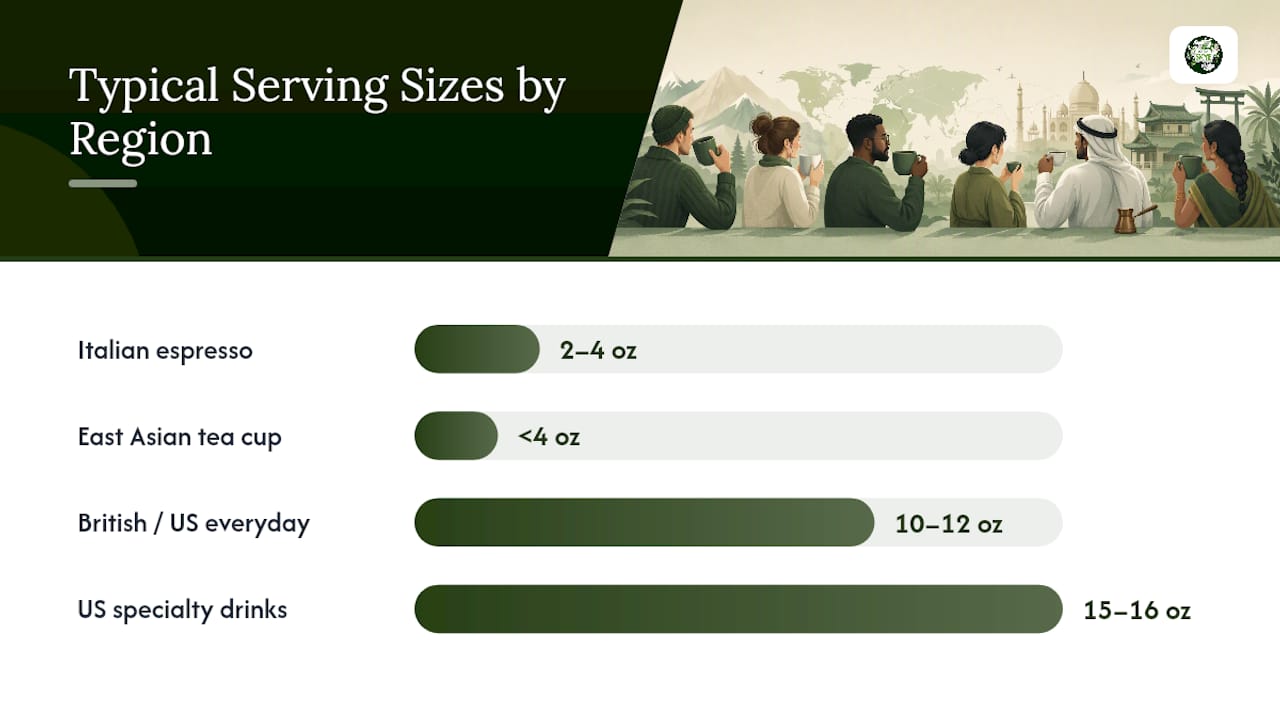
In much of continental Europe, particularly in espresso-focused cultures like Italy, the default serving vessel is small, often closer to 2 to 4 oz for a proper espresso cup. Coffee is treated as a short, concentrated experience rather than something to sip over an hour, so the vessel is built for the drink, not for lingering.
British tea culture runs in the opposite direction for tea mugs, favoring larger capacities, often in the 10 to 12 oz range, built for milky tea drunk over a longer stretch. American diner and home mug culture sits closer to that British range for everyday coffee, but pushes further into 15 and 16 oz territory for specialty drinks, milkshake-style iced coffee, and the "bigger is better" instinct that shows up across a lot of American product categories.
East Asian tea culture often goes smaller still for traditional tea sets, with individual cups sometimes under 4 oz, designed for repeated small pours rather than one large serving. None of these regional habits are wrong. They just reflect what the drink and the culture around it actually call for.
Why the Same Coffee Tastes Different in a Different-Sized Mug
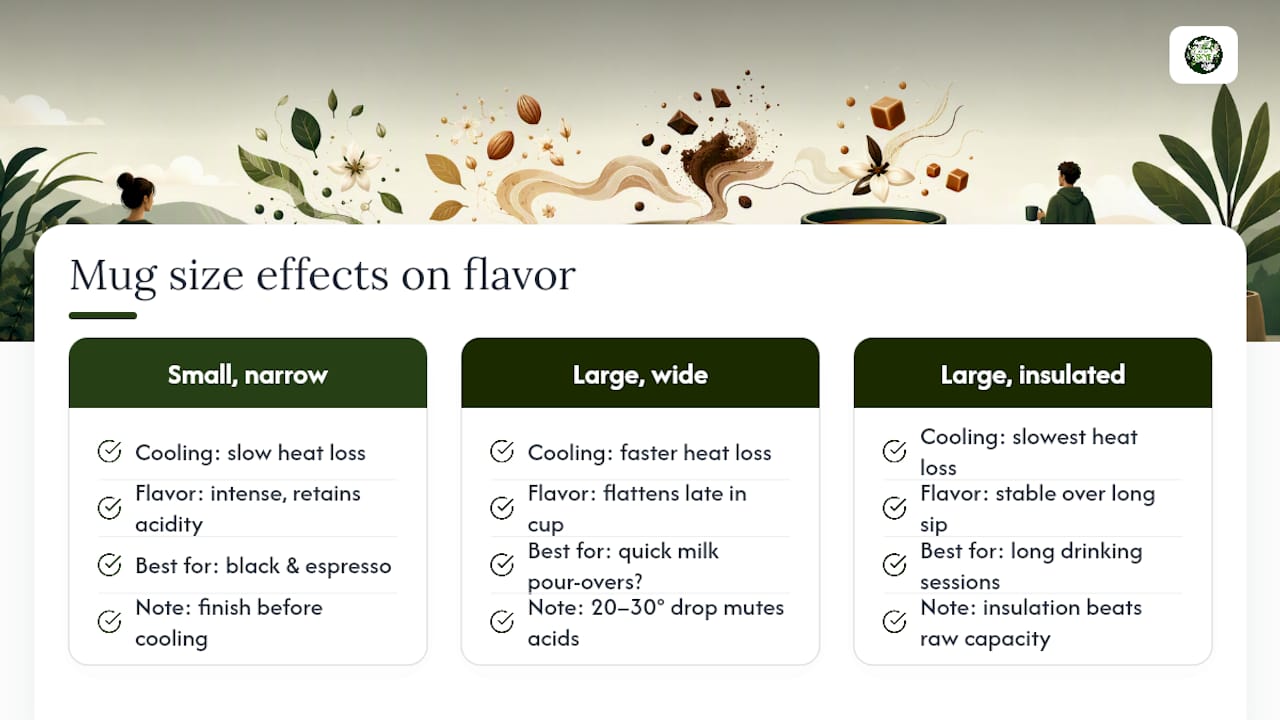
The mug you pour into changes more about your drink than most people realize, and it has nothing to do with the coffee itself. Volume affects cooling rate directly: more liquid in a wider container loses heat to the air faster than the same liquid in a smaller, narrower vessel, since surface area exposed to room temperature air is doing most of the work.
That's why a large mug of black coffee often tastes flatter by the last third of the cup. It's not that the coffee changed. It's that a 20 to 30 degree temperature drop mutes bitterness and acidity, which shifts the whole flavor profile toward dull. A smaller mug sidesteps this because you finish the drink before that drop happens.
Concentration plays a role too, separate from temperature. A smaller vessel with the same amount of coffee grounds per ounce of water delivers a more intense first impression, which is part of why espresso works in a 2 to 3 oz cup and would taste diluted and strange in a 12 oz one. Milk-based drinks flip this logic. Lattes and cappuccinos need the extra volume of a 12 to 16 oz mug specifically because the ratio of milk to coffee is the whole point of the drink.
If you're chasing maximum flavor perception on a straight black coffee or espresso-based drink, smaller and narrower wins. If you want a drink that stays comfortable to hold and drink over twenty or thirty minutes, a bit more volume and an insulated wall will serve you better than raw capacity ever will.
An Honest Take on Sizing Advice That Oversimplifies
Most sizing guides treat mug capacity like it's the only variable that matters, and that's the part I'd push back on. The research on cooling behavior makes it clear that shape and wall thickness often move the needle more than the ounce number printed on the box. Two mugs at 12 oz can behave completely differently depending on whether they're wide and shallow or tall and narrow.
The other place conventional advice falls short is gifting. A lot of guides default to "bigger is a safer gift," but the seller data actually shows 11 oz mugs carry less breakage risk and lower cost, while 15 oz only wins on the "feels generous" factor, not on practicality. If you know the person drinks black coffee fast, a smaller mug is the better gift, full stop.
What I'd prioritize first, before anything else, is matching the mug to how you actually drink, not to what looks impressive on a shelf. Buy the 11 to 12 oz size unless you have a specific reason not to. Add a bigger one later if your habits genuinely call for it.
— Skye
Get a Mug Sized Right for Your Routine
Everything in this guide points to the same conclusion: the right mug fits your habits, not just your cabinet space. Sincerely Skye's lineup runs the full range this guide covers, from everyday 11 oz pieces to roomier 15 and 20 oz options, all with the whimsical, craft-inspired designs that make a mug worth reaching for every morning.
If none of the standard sizes feel right, the custom mug builder lets you pick your own size and design instead of settling for whatever a big-box store happens to stock. Browse the full lineup on the Sincerely Skye shop and find a size that actually matches how you drink your coffee, not just how it looks on a shelf.
Sources
This guide leans on a few practical, size-focused references worth bookmarking:
- Standard Coffee Mug Sizes: Oz & ML Chart | CoffeifyMug
- Coffee Cup Sizes Guide for Cafés & Wholesale Buyers
- 11 oz vs 15 oz Mug: Size, Price, Weight & Which One Sells Better for POD