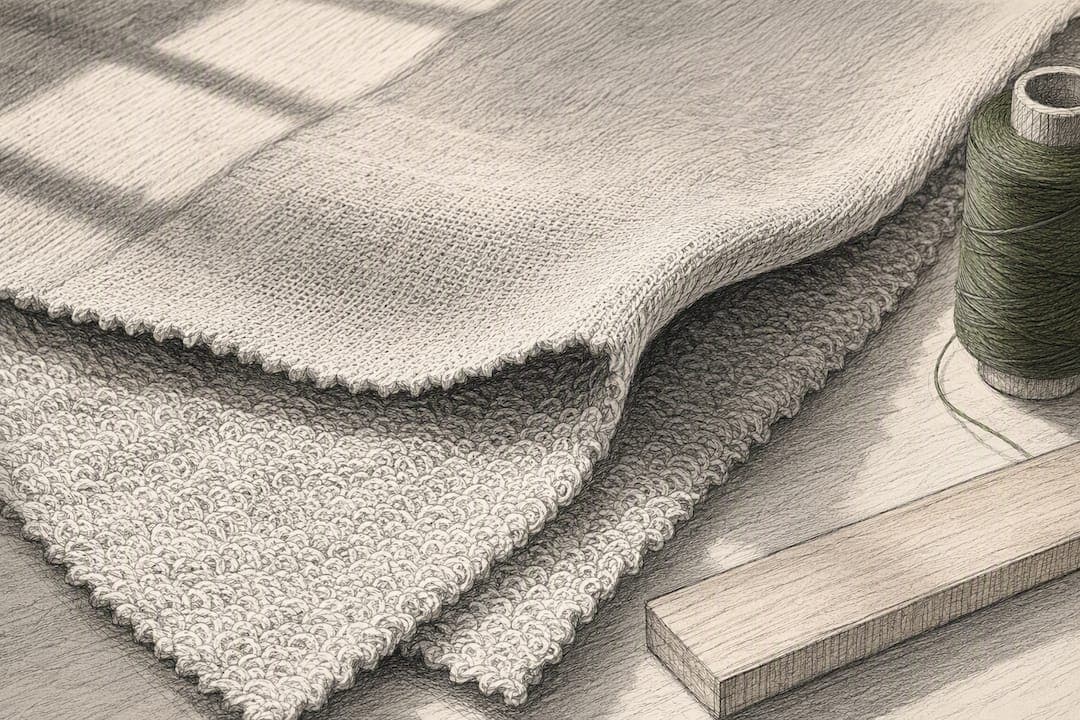
French terry is a knit fabric with a smooth, flat outer face and small uncut loops on the inside, giving it the stretch of a jersey with more body and softness. It shows up most often in hoodies, sweatshirts, joggers, and loungewear because it breathes better than fleece while still feeling substantial.
TL;DR:
- French terry is a knit fabric with small uncut loops on the inside, making it lighter and more breathable than fleece but still structured.
- Its feel and performance depend on knitting variables like stitch length, yarn count, and machine gauge, which influence softness, stretch, and shrinkage.
- Compared to fleece, terry cloth, and jersey, French terry traps less heat and moisture, making it suitable for light layering and activewear, but less for heavy insulation or high absorbency.
- The fabric typically ranges from 200 to 350 GSM, with midweight options around 280 to 350 GSM favored for everyday sweatshirts and hoodies.
- Proper care, including washing in cold water and air drying, minimizes shrinkage and prolongs garment lifespan, especially for higher-quality French terry with ring-spun cotton.
Table of Contents
- How French terry is knit and why it feels the way it does
- French terry compared to fleece, terry cloth, and jersey
- Where French terry shows up in everyday garments
- What GSM tells you about weight, warmth, and drape
- Washing and drying French terry without losing shrinkage battles
- Weighing the benefits against the trade-offs
- A shopper's checklist for choosing French terry
- Why fabric marketing terms often mislead shoppers
- Find French terry pieces built with weight and care details up front
- Where these fabric facts come from
- Sources
- FAQ
How French terry is knit and why it feels the way it does
French terry starts as a knit, not a weave, which is why it stretches more than a woven cotton twill or denim. Knitting machines produce two distinct surfaces: a smooth "technical face" you see on the outside of the garment, and a looped "technical back" on the inside that touches your skin. Those interior loops come from what the industry calls a 2-end construction, where floated yarns are caught only periodically instead of being knit into every stitch. That floating creates the small, soft loops that give French terry its texture without adding the brushed nap you'd find on fleece.
This is actually why some manufacturers describe French terry as an un-napped fleece: it shares a similar knit structure with fleece, but skips the brushing step that raises fibers into a fuzzy pile. Understanding how single and double knits are built helps explain why French terry drapes and stretches differently than a plain single-jersey tee.
The specific feel of a French terry fabric, whether it's soft and lightweight or thick and substantial, comes down to a few knitting variables working together. Stitch length determines how loose or tight the loops sit, which affects both softness and how much the fabric will shrink after washing. Yarn count (finer or coarser) changes the fabric's weight and hand. Machine gauge, or how many needles are packed into the knitting cylinder, controls loop density and how smooth or textured the surface feels. A brand that specifies these details on a product page is generally more transparent about what you're actually buying than one that just says "soft, cozy fabric."
French terry compared to fleece, terry cloth, and jersey
Shoppers often lump French terry in with fleece or terry cloth, but the three fabrics behave differently enough to matter for how a garment performs.
- Fleece is typically brushed to raise a fuzzy nap on one or both sides, which traps more air and makes it warmer and heavier than French terry.
- French terry keeps its interior loops un-napped, so it's lighter, more breathable, and less insulating than brushed fleece.
- Terry cloth, the fabric used in bath towels, is woven rather than knitted and packs in denser loops specifically for high absorbency, which also makes it stiffer and less stretchy.
- Jersey is a single-sided smooth knit with no interior loop structure at all, so it lacks the texture and moderate absorbency that French terry's loops provide.
These structural differences carry through to real-world performance. Fleece traps more warmth but takes longer to dry and can pill faster where friction is high, like underarms or sleeve cuffs. Terry cloth soaks up water efficiently but isn't built for stretch or shape retention, which is why you won't find it in joggers. French terry sits in between: it handles light moisture and warmth reasonably well, dries faster than fleece, and takes screen printing cleanly because its technical face is smooth rather than looped or brushed. Jersey remains the better pick when you want maximum drape and minimal bulk, but it won't give you the same cushioned hand feel.
Where French terry shows up in everyday garments
French terry earns its place in casual wardrobes because it balances comfort, structure, and breathability better than most alternatives in the same weight class.
- Hoodies and sweatshirts use French terry for the body panels because it holds shape without feeling stiff.
- Joggers benefit from the fabric's stretch and recovery, especially around the waistband and ankle cuffs.
- Lightweight tees and loungewear use thinner French terry when a brand wants texture without sweatshirt bulk.
Design details often reveal the fabric underneath even before you touch it. Ribbed cuffs, waistbands, and hood linings are frequently made from a tighter rib knit paired with a French terry body, since the rib provides recovery where the garment needs to hug the skin. Midweight French terry in particular works well for layering during transitional weather, since it adds warmth without the heat retention of a heavier fleece.
What GSM tells you about weight, warmth, and drape
GSM, or grams per square meter, is the standard way fabric weight gets measured, and it's a far more useful comparison tool than vague labels like "midweight" or "heavy." Lighter French terry generally falls around 200 to 240 GSM and suits warm-weather layering or tees with texture. Midweight versions, common in everyday sweatshirts, typically run from about 240 to 320 GSM, and this is the range covered in more detail in this comparison of fleece and French terry weights. Heavier French terry above 320 GSM shows up in cold-weather hoodies and structured joggers where drape matters less than durability.

Stitch length and yarn count shift these numbers even within the same weight category, and looser stitches tend to shrink more during laundering than tightly knit ones. When you're comparing garments, look for the actual GSM number on the product page rather than relying on marketing adjectives, since "heavyweight" from one brand might be another brand's "midweight."
Washing and drying French terry without losing shrinkage battles
Cotton knits, including French terry, are prone to some shrinkage after the first few washes, and the industry standard for measuring that change is AATCC Test Method 135, which sets home-laundering conditions used to test dimensional change in fabrics. That standard exists because shrinkage isn't random: it's tied to how the fabric was knit and processed before it ever reached a store shelf.
Manufacturing choices play a bigger role than most shoppers realize. Wet-processing tension and knitting parameters such as stitch length, yarn count, and machine gauge all affect how much a garment will shrink or distort once it's washed at home. A garment knit with tighter tension and finished properly should hold its shape better over time than one rushed through processing.
For everyday care, a few habits go a long way:
- Wash French terry in cold or warm water rather than hot, since heat accelerates shrinkage in cotton knits.
- Use a gentle cycle to reduce the mechanical agitation that distorts loops and prints.
- Skip the dryer's high-heat setting, or air dry when possible, especially for printed garments.
- Turn garments inside out before washing to protect both the printed design and the interior loop structure.
Ring-spun cotton, common in higher-quality French terry, typically falls in a 3 to 7% shrinkage range after initial washes, which is worth knowing before you size up or down.
Pro Tip: Check the care label before your first wash and follow the lowest heat setting listed. If a product page doesn't mention expected shrinkage, washing guidance built for hoodies and printed sweatshirts can help you avoid surprises.

Weighing the benefits against the trade-offs
French terry earns its popularity honestly, but it isn't the right fabric for every use case.
- Comfortable hand feel: the interior loops create a soft touch without added bulk.
- Breathability: it traps less heat than brushed fleece, making it wearable across more of the year.
- Stretch and recovery: knit construction, especially with a bit of spandex, moves with the body.
- Lower absorbency than towel terry: it won't perform like a bath towel if heavy moisture-wicking is the goal.
- Less insulating than heavyweight fleece: cold-climate outerwear usually calls for a warmer fabric instead.
- Pilling potential: lower-quality yarns or loose knits can pill faster with regular wear and washing.
If you need serious water absorption, woven terry cloth remains the better choice. If you need maximum warmth for genuinely cold conditions, a heavier brushed fleece will outperform French terry every time.
A shopper's checklist for choosing French terry
A little label-reading before checkout saves you from a garment that looks right in photos but disappoints once it arrives.
- Check the listed GSM or weight description and compare it against the midweight sweatshirt range you're targeting.
- Confirm fiber content: 100% cotton feels softer but may shrink more, while cotton-spandex blends hold shape longer.
- Look for whether the interior is un-brushed (true French terry) or brushed (closer to fleece), since sellers sometimes blur the line.
- Test stretch and recovery if you can, or read reviews that mention how the garment holds up after multiple washes.
- Inspect seam construction, particularly at the shoulders and cuffs, for reinforced stitching.
- Read the care instructions closely, and treat vague or missing shrinkage guidance as a red flag.
Watch for listings that describe weight only in adjectives ("cozy," "heavyweight") without a GSM figure, since that usually means the seller hasn't tested or doesn't want to commit to a number.
Pro Tip: If a product page won't tell you the GSM or expected shrinkage, message the seller directly. A brand that knows its own fabric specs usually shares them without hesitation.
Why fabric marketing terms often mislead shoppers
Most fabric marketing leans on adjectives instead of numbers, and that's exactly backward from what actually helps a buyer decide. "Cozy" and "premium" tell you nothing measurable, while a GSM figure, fiber percentage, and shrinkage range tell you almost everything you need before you click buy. Sellers who publish those numbers are betting on their fabric holding up to scrutiny, and that's a reasonable signal of confidence.
The bigger issue is that "French terry" gets used loosely across the industry, sometimes for genuinely un-napped, loop-back knits and sometimes for fabric that's closer to lightweight fleece. Reading the technical face and back descriptions, not just the fabric name, tells you more about what you're actually getting than the label alone.
— Skye
Find French terry pieces built with weight and care details up front
Cozy, craft-inspired hoodies and sweatshirts often use French terry for breathable comfort without the bulk of heavier fleece, and enough structure to carry vintage-inspired artwork cleanly. Product pages often list fabric details to help you know what you're getting before checkout.
Midweight French terry in the 280 to 350 GSM range is a common sweet spot for everyday sweatshirts, balancing warmth with breathability for year-round layering. If you're shopping for a hoodie built around that kind of comfort, The Hoodie from Sincerely Skye Gear is a good place to start, and the wider Sincerely Skye Gear collection carries the same craft-inspired artwork across other French terry pieces.
Where these fabric facts come from
Claims here draw on AATCC TM135 for shrinkage testing standards, CottonWorks for knit structure and processing effects, and FabricAtlas for fabric comparisons. Readers researching sustainable fiber choices can also see this guide to eco-friendly fabric materials.
Sources
FAQ
Is French terry higher quality than other knit fabrics?
Quality depends more on yarn type, knit tightness, and finishing than on the fabric name alone. A well-knit French terry with a documented GSM and ring-spun cotton content will outperform a loosely knit version with vague specs, regardless of label.
Can French terry be 100% cotton?
Pure cotton versions tend to feel softer but may shrink somewhat more during the first few washes.
What are the downsides of French terry fabric?
French terry absorbs less moisture than woven terry cloth and insulates less than heavier brushed fleece, so it isn't ideal for towels or serious cold-weather outerwear. Lower-quality yarns can also pill with repeated washing and wear.
What is the difference between terry and French terry?
Terry cloth, used in towels, is woven with dense loops on both sides specifically for high absorbency. French terry is knitted rather than woven, with loops only on the interior and a smooth face outside, giving it more stretch and less absorbency than true toweling terry.