Pick DTF for small runs, mixed fabrics, and full-color or photographic designs. Pick screen printing for large cotton runs where soft, in-the-fabric hand and lower per-unit cost at volume are the priority. That's the core of the screen print vs DTF decision, and most orders fall cleanly into one camp or the other.
- DTF wins when: you need a small number of pieces, your design has gradients or photographic detail, or your garments are a mix of cotton, polyester, and blends.
- Screen printing wins when: you're ordering 100+ pieces on cotton, your design uses 1–4 spot colors, and a soft, breathable hand matters to your brand aesthetic.
- Hybrid makes sense when: you're printing a large back graphic in one or two colors (screen print it) and a small, full-color chest crest (DTF it) on the same garment.
Three signals that should steer your decision immediately: your order quantity, your color count, and your fabric mix. If all three point the same direction, the choice is straightforward. When they conflict, the sections below will sort it out.
Pro Tip: If you're ordering a sample run of 12 tees for a craft show with a multicolor vintage design, DTF is almost always the faster and cheaper path. Screen printing's setup costs don't amortize until you're well past that quantity.
Key Takeaways
The right printing method depends on three numbers: your order size, your color count, and your fabric mix. Get those right and the decision usually makes itself.
| Point | Details |
|---|---|
| DTF for small, colorful runs | DTF has no setup fees and handles unlimited colors, making it the better choice under roughly 48 pieces for simple designs. |
| Screen printing wins at volume | Per-piece cost drops to $0.60–$1.20 at 500+ pieces, far below DTF's flat $1.05–$1.95 range. |
| Both survive 50+ washes | Durability is comparable when cured correctly; screen printing bonds into fibers, DTF bonds to the surface. |
| Crossover depends on color count | A one-color design crosses over near 48 pieces; multi-color designs may not cross over until 250–500 pieces. |
| Hybrid approach works for complex projects | Screen print large spot-color graphics and DTF small full-color details on the same garment to optimize cost and hand. |
Table of Contents
- How does screen print vs DTF compare at a glance?
- How does DTF printing actually work?
- How does screen printing work, and what controls the feel?
- How do print quality, feel, and durability actually compare?
- What do screen printing and DTF actually cost, and when does one become cheaper?
- How long do prints last, and how should you care for them?
- What are the pros and cons of each method?
- How do you decide which method to use, and what should you ask a printer?
- Expert tips for achieving soft, high-quality screen-print finishes
- Is DTF replacing screen printing?
- A note from Skye on how this applies to our merch
- Sources
How does screen print vs DTF compare at a glance?
| Dimension | DTF | Screen Printing |
|---|---|---|
| Best for | Small runs, full color, mixed fabrics | Large runs, spot colors, cotton |
| Setup cost | Low (no screens) | $15–$25 per color per screen |
| Per-unit cost shape | Relatively flat across quantities | Drops sharply as volume rises |
| Minimums | None to very low | Typically 12 pieces minimum |
| Print quality / detail | Excellent for photos, gradients, fine lines | Excellent for spot color, halftones, bold graphics |
| Color handling | Unlimited colors, full CMYK | Each color = one screen; spot or simulated process |
| Hand / feel | Smooth film on surface; can be thin and flexible when pressed correctly | Soft, in-the-fabric feel with discharge or water-based inks |
| Fabric compatibility | Cotton, polyester, blends, nylon, fleece, canvas | Best on cotton; polyester requires low-bleed inks |
| Durability / washability | 50+ washes when cured correctly; may thin or delaminate on poor substrates | 50+ washes on cotton; tends to crack before delaminating |
| Turnaround | Same day to 2 business days | 3–10 business days depending on quantity |
| Environmental / cleanup | Powder waste; no water-intensive screen washout | Water and solvent use for screen reclaiming; plastisol requires proper disposal |
Cost estimates from published shop data put DTF at roughly $1.05–$1.95 per print across most quantities, while screen printing can start high on small runs and fall to $0.60–$1.20 at large volumes once setup fees are amortized. Actual numbers depend on your vendor, ink chemistry, and garment blank.
The crossover point where screen printing becomes cheaper than DTF varies by color count and shop economics: some shops cite roughly 48 pieces for a one- or two-color design, while other analyses push that crossover toward 250–500 pieces when multiple colors are involved.
How does DTF printing actually work?
DTF stands for direct-to-film. The process prints your artwork onto a special PET (polyester) film, then transfers it to the garment via heat and pressure. Here's the full workflow:
- Artwork preparation. Your design file is processed in RIP software that separates the image into CMYK layers plus a white underprint layer.
- Film printing. A DTF printer lays down the color layers first, then floods a white ink underprint over the entire design. The white layer is what makes colors pop on dark garments.
- Powder adhesive application. While the ink is still wet, hot-melt powder adhesive is applied evenly over the printed surface. Excess powder is shaken off.
- Curing. The film passes through a conveyor oven or sits under a heat source to melt and bond the adhesive to the ink. This creates the transfer "flake."
- Heat-press transfer. The cured film is placed ink-side down on the garment and pressed at around 300–310°F for 10–15 seconds. The film peels away, leaving the print bonded to the fabric.
- Final cure. A second press or additional dwell time sets the adhesive fully into the fabric surface.
Equipment and materials involved:
- DTF printer (modified inkjet or purpose-built)
- Pigment-based CMYK inks plus white ink
- PET film (the carrier sheet)
- Hot-melt powder adhesive (fine or coarse grain)
- Conveyor oven or curing station
- Heat press
DTF bonds mechanically to the fabric surface rather than chemically penetrating fibers. That's why it works across almost any substrate: cotton, polyester, nylon, fleece, canvas, and blends. It sidesteps the dye migration problems that complicate screen printing on polyester, where heat can cause dye to bleed into plastisol ink.
Pro Tip: Pressing temperature and adhesive amount are the two biggest variables in DTF quality. High-quality DTF pressed at correct temps (around 300–310°F) with controlled adhesive produces a thin, flexible print. Too much powder or too low a temperature leaves a thick, plastic-y film you can feel from across the room.
Quick checklist for auditing a DTF sample from a supplier:
- Run your finger across the edge of the print. Clean adhesion with no lifting? Good sign.
- Feel the hand. Does it flex with the fabric or sit stiff on top?
- Wash the sample cold, inside-out, and check for edge peeling or color loss after 5 washes.
- Hold it up to light. Excessive opacity or a visible film border suggests too much adhesive.
How does screen printing work, and what controls the feel?
Screen printing forces ink through a mesh screen onto the garment using a squeegee. The mesh acts as a stencil: open areas let ink through, emulsion-coated areas block it. The process is older than DTF by decades, but the variables that control quality are just as technical.
The step-by-step process:
- Film positives. Each color in your design is output as a separate film positive (or printed directly to screen with a CTS system).
- Screen exposure. Each film is laid on a mesh screen coated with light-sensitive emulsion and exposed to UV light. The emulsion hardens everywhere except where the design blocks light, leaving open mesh in the image area.
- Press setup. Screens are loaded onto the press in registration. An underbase screen (usually white) is set up first for dark garments.
- Printing passes. The squeegee pulls ink across the screen, forcing it through the mesh onto the garment. Each color requires a separate pass, often with a flash cure between colors to prevent wet-on-wet smearing.
- Curing. Finished garments pass through a conveyor dryer at 320°F (plastisol) or 300–320°F (water-based) to fully cure the ink.
Materials that matter:
- Mesh counts: Low meshes (110–160) for underbases and opaque blocks; higher meshes (230–305) for halftones and fine detail. Thread diameter (S, T, HD) also affects ink deposit and feel.
- Squeegees: Durometer (hardness) and blade angle control ink deposit. A 45–60° angle with enough pressure to clear the image without driving excess ink into the garment is the target.
- Inks: Plastisol is the industry standard — durable, opaque, and forgiving. Water-based inks absorb into fibers for a softer hand but require more precise curing. Discharge inks chemically remove the dye from the fabric and replace it with pigment, producing the softest, most breathable hand possible on reactive-dyed cotton.
The print technique guide from Avient Specialty Inks makes clear that mesh selection, squeegee angle and pressure, emulsion thickness, and screen tension all directly affect hand, detail, and durability. Getting these variables right is what separates a stiff, cracking print from one that outlasts the garment.
Pro Tip: For a vintage, soft-hand finish on cotton, discharge or water-based inks on a higher mesh (230+) with a controlled ink deposit will give you that "printed into the shirt" look. Plastisol on a low mesh with heavy pressure does the opposite: you get opacity, but the hand suffers.
Multi-color designs require a separate screen per color, which is why setup costs scale with color count. Halftone simulation (printing photographic images with dot patterns) is possible but adds complexity and requires tight mesh tension and precise registration.
How do print quality, feel, and durability actually compare?
This is where the choice gets real. Both methods can produce beautiful work. They fail in different ways and excel in different situations.
Print quality and color handling
DTF handles gradients, photographic images, fine linework, and tiny type without any additional setup cost per color. The CMYK process prints all colors in one pass. Screen printing handles spot colors and bold graphics with exceptional crispness, but photographic simulation requires halftone dots and careful mesh selection. Fine linework below about 1 point can be tricky on screen printing due to emulsion bridging and mesh interference.
For a design with 15 colors and a gradient sky, DTF is the obvious call. For a three-color vintage badge with bold outlines, screen printing will likely look sharper and feel better on the garment.
Hand and feel
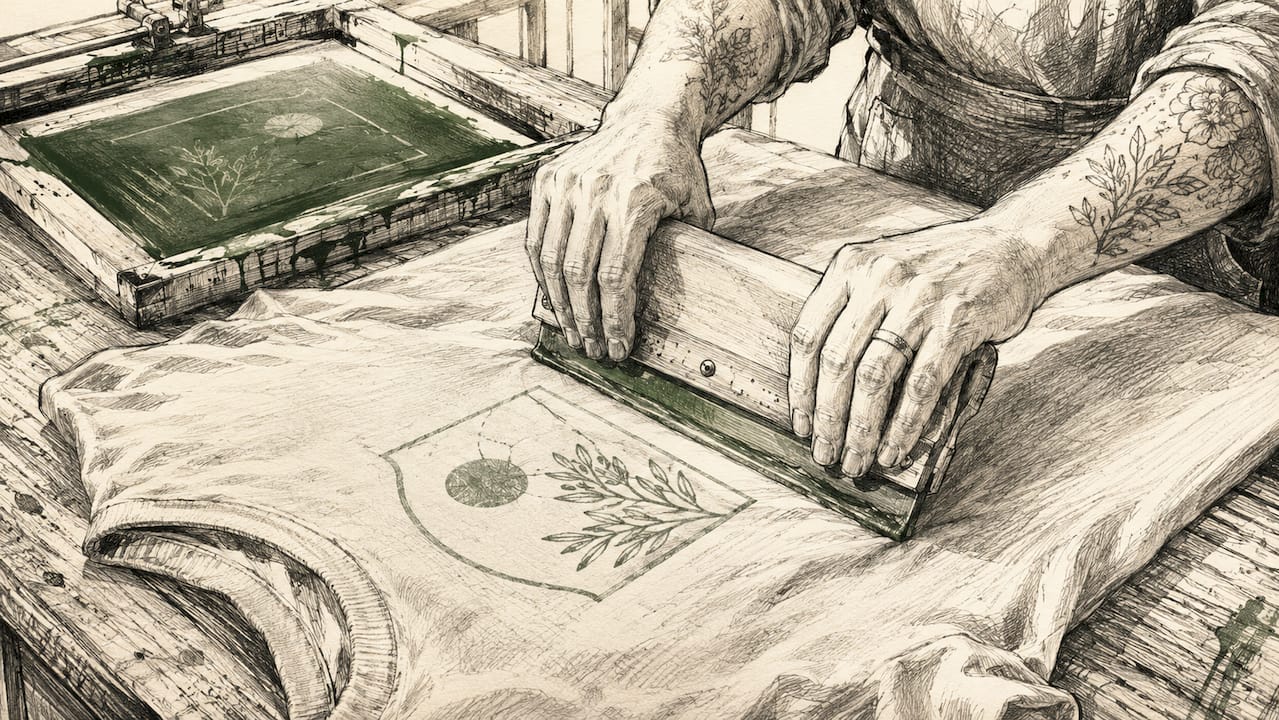
This is the dimension that matters most for craft-style and vintage-inspired apparel. Screen printing with discharge or water-based inks on cotton produces a hand that feels like part of the shirt. DTF sits on the surface. On a small chest logo (3–4 inches), the difference is barely noticeable. On a large full-front print, you feel the DTF film when you put the shirt on.
That said, modern DTF executed well is far softer than old heat-transfer vinyl. The difference often comes down to powder adhesive control and cure parameters. A well-pressed DTF print on a tri-blend tee can feel surprisingly natural.
Durability and how each method fails
Both methods can survive 50+ washes when done correctly. The failure modes differ. Screen prints on cotton tend to crack over time, especially with plastisol on a low mesh with heavy ink deposit. DTF tends to thin and eventually delaminate, particularly on high-stretch fabrics or when the initial press was undercured.
Screen printing generally outlasts the garment on well-cured cotton. DTF often performs better on polyester and mixed fabrics because it doesn't rely on fiber penetration.
Fabric compatibility at a glance:
- DTF advantage: Polyester, nylon, tri-blends, fleece, canvas, mixed-fabric garments, dark synthetics
- Screen printing advantage: 100% cotton, ringspun cotton, cotton-rich blends where discharge or water-based inks can penetrate
- Screen printing caution: High-polyester content causes dye migration into plastisol; requires low-bleed specialty inks
- DTF caution: High-stretch fabrics (spandex-heavy) can stress the mechanical bond; test before a full run
What do screen printing and DTF actually cost, and when does one become cheaper?
Setup cost is the defining economic difference. DTF has none. Screen printing charges $15–$25 per color per screen, so a four-color design costs $60–$100 in setup before a single shirt is printed.
Cost ranges by order size
Figures drawn from published shop estimates. Garment cost is separate. Actual quotes will vary by vendor, ink system, and design complexity.
The crossover point is not a fixed number. Shop experience shows it depends heavily on color count and shop economics: roughly 48 pieces for a one- or two-color design, but potentially 250–500 pieces or higher when you factor in multiple colors and their setup fees. Always get a quote with your specific color count before assuming one method is cheaper.
Turnaround times
- DTF: Same day to 2 business days for most orders. No screen-making step means faster starts.
- Screen printing: 3–10 business days depending on quantity, press availability, and whether new screens need to be made.
For rush jobs, a practical timeline checklist:
- Confirm your artwork is print-ready (vector or high-res) before contacting the printer.
- Ask specifically about rush fees and whether they affect the print queue or just the setup.
- For screen printing, ask if screens from a previous run still exist (reusing them saves a day).
- For DTF, ask about same-day or next-day availability and whether there's a premium.
- Build in at least one business day buffer for shipping if the printer is not local.
Screen printing's longer lead time is a real operational constraint for small brands doing seasonal drops or craft show restocks on short notice.
How long do prints last, and how should you care for them?
Both methods hold up well when the garment is cared for correctly. The variables that shorten print life are almost always washing temperature, dryer heat, and whether the print was properly cured in the first place.
Recommended care for both methods:
- Wash cold, inside-out, on a gentle cycle.
- Avoid enzyme-based detergents for DTF prints when possible; enzymes can degrade the adhesive layer over time.
- Tumble dry low or line-dry. High dryer heat accelerates cracking in plastisol and can stress DTF adhesive bonds.
- Never iron directly on a print. Use a pressing cloth or press from the inside.
- Skip fabric softener on DTF prints; it can reduce adhesion over repeated washes.
Curing quality at the production stage is the biggest predictor of longevity. For screen printing, plastisol must reach 320°F throughout the ink layer, not just at the surface. For DTF, the transfer press temperature and dwell time determine how well the adhesive bonds to the fabric. Ask your vendor for their curing temperatures and dwell times before placing a large order.
When both methods are executed correctly, prints can exceed 50 washes with minimal visible degradation. Screen printing on cotton tends to outlast the garment itself when discharge or water-based inks are used with proper cure. DTF on polyester blends often holds up better than screen printing on the same fabric because the mechanical bond doesn't depend on fiber penetration.
Pro Tip: If you sell apparel online, include specific washing instructions on your product pages. Early print failures are almost always a care issue, not a production defect. A single line ("wash cold, inside-out, tumble dry low") reduces returns and negative reviews from customers who ran their new tee through a hot wash.
What are the pros and cons of each method?
DTF pros and cons
Pros:
- No minimums and no setup fees per color
- Prints full-color, photographic, and gradient designs without added cost
- Works on virtually any fabric type or color
- Fast turnaround, often same day to 2 business days
- No dye migration issues on polyester
- Soft and flexible when pressed correctly with controlled adhesive
Cons:
- Per-piece cost stays flat and doesn't drop with volume
- Print sits on the fabric surface rather than bonding into fibers
- Large full-front prints have a noticeable film hand compared with discharge screen printing
- Powder adhesive waste requires proper disposal
- Quality varies significantly by printer; poor pressing produces a stiff, plastic-y result
- High-stretch fabrics can stress the mechanical bond over time
Screen printing pros and cons
Pros:
- Per-unit cost drops sharply at volume, making it the most cost-efficient method for large runs
- Discharge and water-based inks produce a soft, breathable, in-the-fabric hand
- Ink chemically bonds to cotton fibers for exceptional washfastness
- Halftone and spot-color work looks crisp and vibrant
- Established, predictable process with decades of quality benchmarks
Cons:
- Setup fees ($15–$25 per color) make small runs expensive
- Each color requires a separate screen, adding time and cost for complex designs
- Polyester and synthetic fabrics require specialty low-bleed inks
- Longer turnaround (3–10 business days) compared with DTF
- Screen reclaiming uses water and solvents; plastisol ink requires proper disposal
- Photographic and gradient designs require halftone simulation, which adds complexity
How do you decide which method to use, and what should you ask a printer?
Decision checklist
- Count your colors. One to four spot colors? Screen printing is likely cheaper at moderate volume. Five or more, or any gradients? DTF wins on setup cost.
- Check your order size. Under 48 pieces on a simple design? DTF. Over 100 pieces on cotton with few colors? Screen printing. In between? Get quotes for both.
- Identify your fabrics. Mixed fabrics, polyester, or specialty blends? DTF handles them without extra steps. Pure cotton? Either method works; screen printing with discharge gives the softer hand.
- Define your hand priority. Vintage, soft, breathable feel? Screen printing with water-based or discharge inks. Full-color detail on a performance fabric? DTF.
- Check your timeline. Need it in 48 hours? DTF. Have a week or more? Either method is viable.
Questions to ask a printer before you commit
- Can you provide a wash sample? (Five washes minimum before you approve a production run.)
- What curing temperature and dwell time do you use for DTF? For screen printing?
- What mesh count do you use for the underbase and for halftones?
- What adhesive powder brand or grade do you use for DTF?
- What's your minimum order quantity, and do you charge rush fees?
- What's your typical turnaround for my order size?
Red flags to watch for:
- Printer can't or won't provide a wash sample before production
- Vague answers on cure temperatures ("we just run it through the dryer")
- No information on mesh counts or ink system when asked
- DTF samples that feel stiff or have visible film borders at the edges
- Screen print samples with heavy, rubbery hand on a simple two-color design
Pro Tip: Always request a sample on the actual garment blank you plan to use, not a generic white tee. Fabric weight, fiber content, and dye type all affect how a print behaves. A sample on a different blank tells you almost nothing useful.
Quick scenario guide
- 12 photo tees for a craft show: DTF. No setup fees, full color, fast turnaround.
- 500 cotton hoodies for a seasonal drop: Screen printing. Per-unit cost advantage is significant at this volume.
- Mixed run of 30 tees and 20 sweatshirts in different colors: DTF. Fabric mix and low quantity favor it.
- Large back graphic (2 colors) plus small full-color chest crest: Hybrid. Screen print the back, DTF the crest.
Expert tips for achieving soft, high-quality screen-print finishes
Getting a truly soft screen-print finish on vintage-style apparel takes more than choosing the right ink. The variables compound: mesh, squeegee, pressure, tension, and cure all interact.
Step-by-step operational tips:
- Set correct off-contact distance. The screen should lift cleanly off the garment immediately after the squeegee passes. Too little off-contact causes smearing and ink buildup; too much requires excess pressure.
- Squeegee angle and pressure. Place the squeegee behind the ink at 45–60° and use enough pressure to clear the image without driving excess ink into the garment. The Avient Specialty Inks print technique guide identifies improper pressure as a primary cause of dot gain, fibrillation, and fiber orientation problems.
- Build opacity with passes, not pressure. Two light strokes with a high mesh build opacity without the heavy ink deposit that causes stiffness. One hard stroke on a low mesh does the opposite.
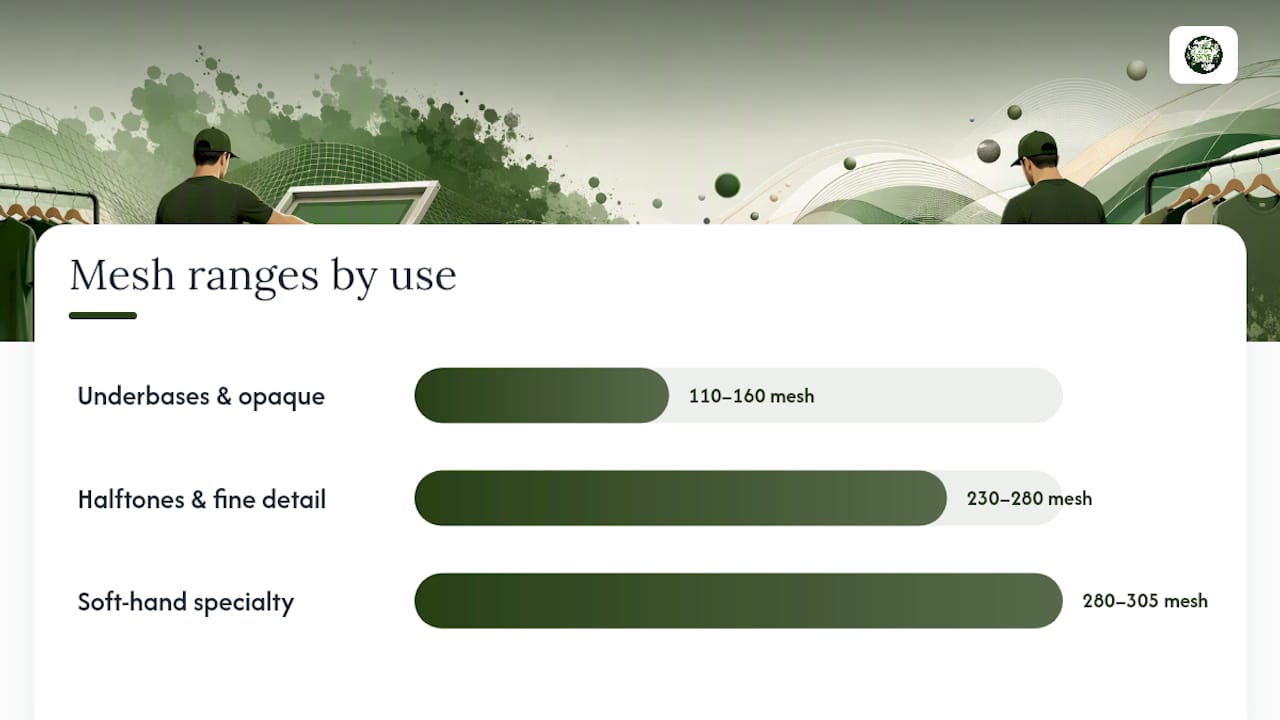
- Choose the right mesh for the job. Use 110–160 mesh for underbases and opaque blocks. Use 230–305 mesh for halftones, fine detail, and soft-hand printing. Thread diameter (S, T, HD) also affects how much ink deposits per stroke.
- Choose the right ink for the hand you want. Plastisol is durable and forgiving but sits on the surface. Water-based inks absorb into fibers for a softer result. Discharge inks remove the fabric dye and replace it with pigment, producing the softest, most breathable hand on reactive-dyed cotton. Avoid discharge on polyester or fabrics with unknown dye chemistry.
- Cure completely, not just at the surface. Plastisol needs to reach 320°F throughout the ink film. Under-cured plastisol cracks early and washes out. Water-based inks need careful temperature control to avoid scorching the fabric while fully curing the ink.
Mesh and thread diameter quick reference:
- 110–160 mesh: underbases, opaque blocks, heavy ink deposit
- 230–280 mesh: halftone simulation, fine detail, moderate ink deposit
- 280–305 mesh: soft-hand specialty printing, thin ink deposit, high detail
Pre-production tests worth running:
- Finger pressure test: After a stroke, press a finger lightly on the print. If ink transfers, pressure is too high or the screen is too close.
- Two-stroke opacity check: Print one stroke, flash cure, print a second. Compare opacity. If two strokes are needed for coverage, consider a lower mesh for the underbase.
- Wash sample procedure: Cure a test print, wash it five times cold inside-out, and inspect for cracking, fading, or edge lifting before approving production.
For Sincerelyskye's vintage-inspired apparel, the soft-hand priority is non-negotiable. A discharge or water-based print on a ringspun cotton tee gives that worn-in, authentic feel that fits the brand's aesthetic. Plastisol on a low mesh would technically work but would undercut the vintage look with a heavy, rubbery surface.
Is DTF replacing screen printing?
No. DTF and screen printing serve different business models and will continue to coexist. The question misframes the relationship.
What DTF actually does to the market:
- Expands capability for small brands, on-demand shops, and anyone who needs full-color prints without minimums
- Makes custom one-offs and short runs economically viable for the first time
- Handles mixed-fabric and polyester orders that screen printing struggles with
- Competes directly with DTG (direct-to-garment) printing, not with screen printing at scale
What keeps screen printing irreplaceable:
- Per-unit cost at volume is still lower than any digital method for simple designs
- Ink-fiber bonding on cotton produces washfastness and a hand that DTF cannot replicate
- Industrial-scale shops running automatic presses at hundreds of pieces per hour have no digital equivalent
- Discharge and water-based techniques produce a garment aesthetic that is genuinely different from any film-on-surface method
The hybrid model in practice:
Many shops now run both. A common workflow: screen print the large back graphic on a seasonal hoodie (two colors, 300 pieces, cost-efficient), then DTF the small full-color chest logo that would require five screens to reproduce in screen printing. The result is a garment that gets the soft-hand benefit of screen printing where it matters most and the full-color flexibility of DTF where detail counts.
Shops that added DTF to their screen-printing operations didn't replace one with the other. They expanded the range of orders they could take profitably.
A note from Skye on how this applies to our merch
Soft hand is the starting point for everything Sincerelyskye makes. When a design is simple enough and the run is large enough, screen printing with water-based or discharge inks on ringspun cotton is the call. That worn-in, breathable feel is what makes a craft-themed tee feel like a favorite shirt rather than a promotional item.
For smaller runs, seasonal pieces, or designs with the kind of full-color vintage detail that would require a dozen screens to reproduce, DTF is the practical answer. The technology has come far enough that a well-pressed DTF print on a quality blank is genuinely soft and holds up through real use.
The honest answer for most small brands is: you'll use both, depending on the project. A flagship seasonal drop at 300 pieces? Screen print it. A limited craft-show run of 15 tees with a detailed watercolor design? DTF all the way.
If you want to see how these choices play out on finished garments, browse the Sincerelyskye store for examples of what soft-hand, vintage-inspired printing looks like in practice. And if you're working on a custom order and want to talk through which method fits your project, reach out directly. Getting the print right from the start is always easier than fixing it after the fact.