
Pick matte when your design is text-heavy, photography-forward, or meant to feel premium and handmade. Pick gloss when you need color to pop, the sticker will live outdoors, or you want maximum shelf impact. That's the short version. The longer version depends on substrate, laminate, and how the sticker will actually be used — and those details are where most ordering mistakes happen.
Quick trade-offs at a glance:
- Color and vibrancy: Gloss boosts perceived saturation noticeably; matte softens and mutes the same colors
- Photographability: Matte scatters light and reduces glare, making it far easier to shoot cleanly for Etsy listings or social media
- Writeability: Matte accepts ballpoint pens and most markers reliably; gloss usually needs a permanent marker and still risks smearing
- Outdoor durability: Both finishes hold up when printed on outdoor-grade vinyl; paper degrades fast regardless of finish
- Cost: Finish alone rarely drives price — substrate, laminate spec, and quantity matter far more
Sincerelyskye's maker-focused perspective: for craft-inspired product labels and packaging stickers, matte is almost always the stronger default. Gloss earns its place on seasonal promos, bright event giveaways, and anything designed to catch a stranger's eye from across a table.
Table of Contents
- What "matte" and "glossy" actually mean when you order stickers
- How matte and glossy finishes change color, contrast, and photographability
- Feel, fingerprints, and scratch visibility on matte vs glossy surfaces
- Durability: water, UV, and why substrate matters more than finish
- Which projects suit matte and which suit glossy finishes
- Can you write on them? Adhesion and application tips
- Price differences, proofs, and what to ask your printer before ordering
- A decision checklist and the exact questions to ask your printer
- How finish aligns with brand identity and photography
- Environmental impact and recyclability of matte vs glossy stickers
- Key Takeaways
- The finish decision most makers get backwards
- Craft-inspired stickers and merch, ready to shop
- Useful sources and further reading
What "matte" and "glossy" actually mean when you order stickers
The terms describe the overcoat applied on top of the printed design, not the ink or the base material. A matte laminate diffuses light across a rough microscopic surface; a gloss laminate reflects light off a smooth one. Both are typically applied as a thin film over the printed layer.
The base substrate sits underneath all of that and matters more for durability than the finish does. Common substrates are paper, BOPP (biaxially oriented polypropylene, a thin plastic film), and vinyl. Paper is the most affordable and the least durable. BOPP handles light moisture and moderate handling. Vinyl is the workhorse for anything outdoors, on water bottles, or on surfaces that get regular contact.
Here's the practical rule: if the sticker needs to survive weather, water, or heavy handling, choose vinyl first, then pick your finish. A glossy laminate on paper is still a paper sticker. 3M's overlaminate guidance for graphics reinforces this same point — the laminate protects the print, but the substrate determines whether the whole assembly holds together under stress.
How matte and glossy finishes change color, contrast, and photographability
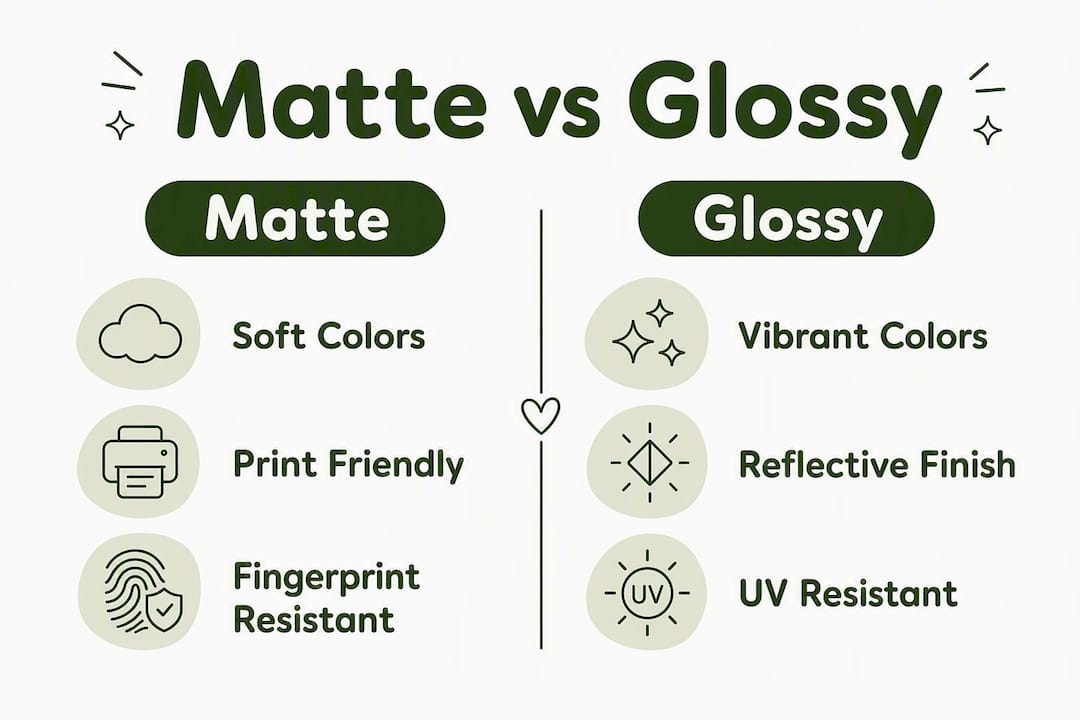
Gloss reflects light back toward the viewer, which creates the perception of deeper contrast and richer color. Matte scatters that same light in multiple directions, producing a softer, more muted result. Neither is objectively better — it depends entirely on what the design needs.
| Attribute | Matte | Glossy |
|---|---|---|
| Color vibrancy | Softer, muted, natural | Brighter, more saturated |
| Contrast | Moderate | Higher perceived contrast |
| Glare under retail/studio lighting | Low | Noticeable, especially under direct light |
| Photography friendliness | Easier to shoot cleanly | Reflections require careful lighting |
| Best for | Text-heavy, subtle, handmade designs | Bold color, illustrations, high-impact retail |
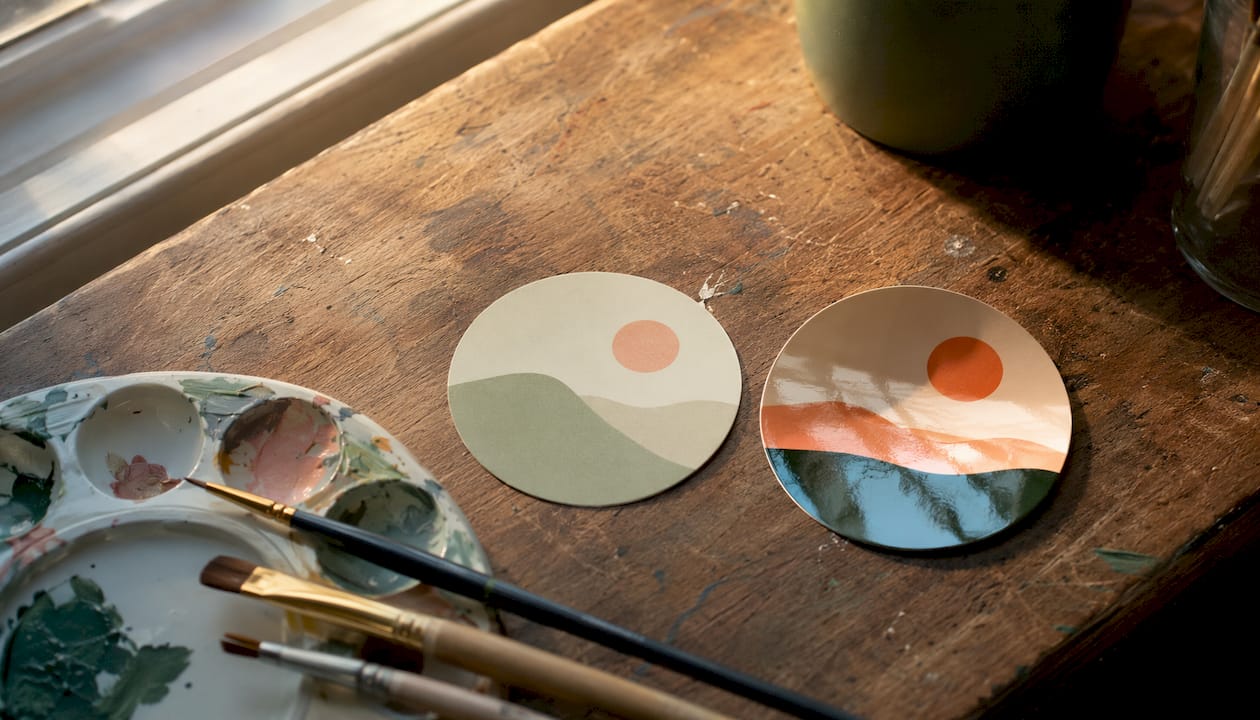
For product photography specifically, matte is the safer choice. Gloss can create hot spots and reflections that require diffused lighting rigs to control. If you're shooting stickers on a phone for an online listing, matte will give you a cleaner, more consistent result with less effort.
Feel, fingerprints, and scratch visibility on matte vs glossy surfaces
Run your finger across a quality matte sticker and it feels almost velvety. Gloss feels slick and smooth. That tactile difference affects how people perceive the product before they even read the design.
Key surface behaviors to know:
- Fingerprints: Matte hides smudges well; gloss shows fingerprints clearly, especially on dark backgrounds
- Scratch visibility: Fine scratches are less visible on matte because the diffuse surface masks them; on gloss, scratches catch light and become obvious
- Perceived quality: Super-matte and soft-touch laminates have become a premium packaging signal — brands use them specifically because the velvety feel reads as high-end
- Gloss durability edge: Gloss laminates are slightly harder and resist surface abrasion marginally better than standard matte
Pro Tip: For laptop stickers, phone cases, or anything handled daily, matte is the practical winner. It won't show every fingerprint, and fine scratches from sliding in and out of a bag stay invisible under most lighting.
Durability: water, UV, and why substrate matters more than finish
Both matte and glossy stickers can be waterproof, weather-resistant, and durable when they share the same quality vinyl base. The finish is not what keeps a sticker alive outdoors. The substrate and laminate thickness are.
Gloss laminates do have a slight edge in water beading and UV deflection. Die-cut stickers with thicker outdoor-grade laminates can last up to five years when specified correctly. Standard roll labels on paper stock are a different story — they're designed for shelf life, not outdoor exposure.
| Application | Recommended substrate | Finish note | Expected lifespan |
|---|---|---|---|
| Outdoor signage / car decals | Outdoor-grade vinyl | Gloss preferred for UV | Up to 5 years (die-cut, thick laminate) |
| Water bottles | Vinyl (waterproof) | Either finish | 1–3 years with quality laminate |
| Product packaging (indoor) | BOPP or paper | Either finish | Shelf life only |
| Laptop / device stickers | Vinyl or BOPP | Matte preferred | 1–2 years typical |
| Short-term event labels | Paper | Either finish | Days to weeks |
For long-term outdoor use or high-handling items, vinyl is the only substrate worth ordering. Paper stickers will degrade quickly regardless of what laminate sits on top.
One environmental note: if the use case is low-stress indoor labeling and sustainability matters, uncoated paper stock without plastic laminate is more recyclable and compostable than vinyl. Vinyl is durable but not easy to recycle in most municipal programs.
Which projects suit matte and which suit glossy finishes
The finish decision gets easier once you know the sticker's job.
Matte works best for:
- Premium product labels (candles, skincare, coffee, apothecary)
- Gift tags and packaging for handmade goods
- Photography-heavy Etsy or social media listings
- Planner stickers and sticker sheets
- Laptop stickers with line art or minimal designs
- Any label with small text, QR codes, or fine detail
Gloss works best for:
- Water bottle stickers and outdoor decals
- Event giveaways and promotional runs
- Bright retail labels and kids' products
- Bold illustrated artwork or colorful mascots
- Bumper stickers and sports team stickers
- Anything designed to catch attention at a distance
The hybrid approach is worth keeping in your toolkit. Many small makers run a core matte line for their everyday product packaging and switch to gloss for seasonal or holiday promos where the goal is visual excitement rather than brand refinement. Sincerelyskye's seasonal collections are a good example of that logic in practice.
Can you write on them? Adhesion and application tips
Writeability is one of the most overlooked differences between finishes, and it causes real frustration after printing.
Pen and marker compatibility:
- Matte accepts ballpoint pens, gel pens, and most markers reliably — ink dries without smearing
- Gloss usually requires a permanent marker (like a Sharpie) and even then may need drying time before touching
- For name tags, date labels, or any sticker someone needs to fill in by hand, matte is the only practical choice
Application and adhesion tips:
- Clean the target surface with isopropyl alcohol before applying — oils and dust kill adhesion
- On curved surfaces (bottles, tumblers), apply from the center outward and use gentle heat from a hair dryer to help the sticker conform
- Press firmly with a credit card or squeegee to eliminate air bubbles
- Ask your printer about adhesive type: permanent vs. removable matters for surfaces like painted walls or laptop lids
Red flags to watch for:
- Liner that tears during peeling (sign of low-quality stock)
- Adhesive that strings or leaves residue on clean surfaces
- No information about whether the laminate is UV-resistant
Price differences, proofs, and what to ask your printer before ordering
Finish alone rarely changes the price meaningfully. What drives cost is substrate (vinyl costs more than paper), laminate thickness, die-cut complexity, and quantity. Gloss is sometimes marginally less expensive at scale because it's the default for many print runs, but the difference is usually small.
Ordering checklist:
- Set up files with at least 0.125 inches of bleed and convert colors to CMYK — RGB files often shift on press
- Request a digital proof before any run, and a physical printed sample before a large order
- For a new design, order a small sample run in both finishes on the same substrate so you can compare them under your actual lighting conditions
- Ask specifically about laminate type: UV-resistant, soft-touch, or super-matte are different products with different performance specs
- Confirm minimum order quantities and turn time upfront — these vary widely between print shops
The single most reliable way to avoid surprises is to order a small sample run of both finishes using the same design and substrate before committing to a large quantity. Screen proofs cannot replicate how a finish interacts with your specific design colors and the surface you're applying to.
A decision checklist and the exact questions to ask your printer
Work through these before placing any order:
- Where will the sticker live? Outdoors or on water-contact surfaces? Specify vinyl and UV-resistant laminate. Indoor only? Paper or BOPP may be fine.
- Does someone need to write on it? If yes, order matte. No exceptions.
- Is photography or social presentation a priority? Matte reduces glare and shoots more cleanly.
- Does the design rely on saturated color or bold contrast? Gloss will serve it better.
- What's the budget and volume? Small test runs in both finishes cost less than reprinting a large order in the wrong finish.
Questions to ask your printer:
- What substrate is this printed on — paper, BOPP, or vinyl?
- What laminate type is included — standard gloss/matte, UV-resistant, or soft-touch?
- What is the outdoor life rating for this spec?
- Can I order a sample run of 10–25 stickers before the full quantity?
- Is the adhesive permanent or removable?
Red flags: A printer who can't answer the laminate type question, offers no sample option, or gives vague outdoor-life estimates ("should last a while") is not a printer you want for anything beyond throwaway labels.
How finish aligns with brand identity and photography
The choice between finishes is fundamentally about light. Gloss reflects to boost saturation; matte diffuses to produce a muted, glare-free look that photographs more consistently. That's not just an aesthetic preference — it's a brand positioning signal.
Matte finishes are preferred for premium, artisanal, and craft-inspired brands because they read as sophisticated and intentional. Gloss signals energy, color, and retail confidence. Neither is wrong — they just speak to different buyer expectations.
For makers selling on Etsy or Instagram, the photography implication is practical: matte stickers on product packaging photograph consistently under natural window light without requiring a diffuser or reflector. Gloss packaging under the same conditions often needs additional setup to avoid hot spots.
Pro Tip: Always order physical samples of both finishes using your actual design before a large run. Lighting in your workspace, the color of your packaging, and the substrate all interact in ways a screen proof cannot predict.
Environmental impact and recyclability of matte vs glossy stickers
Neither vinyl stickers nor plastic-laminated paper stickers are easy to recycle in standard municipal programs. The adhesive layer and laminate film contaminate paper recycling streams, and vinyl (PVC or PE) requires specialized facilities that most curbside programs don't include.
Gloss and matte laminates are both plastic films, so neither has a clear recyclability advantage over the other when applied to vinyl. The substrate is the bigger environmental variable. Paper stickers without plastic laminate are more likely to be accepted in paper recycling or to biodegrade, making them a reasonable choice for short-term indoor labels where durability isn't required.
If sustainability is a priority, look for printers offering water-based adhesives, FSC-certified paper stocks, or biodegradable laminate options. These are niche specs but increasingly available. For most craft and maker applications, the practical trade-off is: use vinyl where durability genuinely requires it, and choose uncoated paper for everything else.
Key Takeaways
Matte wins for photography, writeability, and premium brand positioning; gloss wins for color impact, outdoor durability, and retail shelf presence — but substrate always outranks finish for longevity.
| Point | Details |
|---|---|
| Finish affects look, not lifespan | Both matte and glossy stickers last equally long when printed on the same quality vinyl base. |
| Choose vinyl for outdoor use | Paper degrades quickly outdoors regardless of finish; vinyl with UV-resistant laminate is the only durable option. |
| Matte for writeability and photography | Matte accepts most pens reliably and shoots cleanly without glare — critical for labels and product listings. |
| Gloss for color impact | Gloss boosts perceived saturation and works best for bold, colorful, or high-energy designs. |
| Sincerelyskye's approach | Sincerelyskye uses matte for craft-inspired product stickers and packaging, with gloss reserved for seasonal and promotional runs. |
The finish decision most makers get backwards
Most of the advice you'll find online treats matte vs glossy as a purely visual call. It isn't. The more consequential decision is almost always substrate — and makers routinely order the right finish on the wrong material.
A beautifully designed matte label on uncoated paper looks stunning in a flat-lay photo and falls apart the moment it touches a damp surface. The finish did its job. The paper didn't. That's the mistake worth avoiding.
The other thing worth saying plainly: gloss is not the "professional" choice and matte is not the "artsy" choice. Both can look cheap or premium depending on the design, the substrate, and the print quality. What actually signals quality is specificity — knowing why you chose a finish, what laminate backs it, and whether you tested it physically before ordering 500 units.
For craft brands and small makers, matte tends to be the smarter default because it photographs well, hides handling wear, and reads as intentional rather than generic. But a seasonal gloss run for a holiday collection? That's not a compromise. That's the right tool for the job.
Craft-inspired stickers and merch, ready to shop
If you've worked through this guide and you're ready to see what thoughtful finish choices look like on real craft-inspired products, Sincerelyskye's store is worth a look. Every design is built around the same principles covered here: intentional finish choices, whimsical artwork that holds up in product photography, and a maker-first aesthetic that feels at home on packaging, planners, and everything in between.
The Sincerelyskye store carries stickers, apparel, and accessories designed specifically for crafters and DIY makers — including seasonal collections that show exactly how gloss and matte finishes can serve different creative moments. Browse the full crafters collection to find something that fits your current project or makes a great gift for the maker in your life.
Useful sources and further reading
The research behind this guide draws on finish and material guidance from several print-industry sources worth bookmarking. Paperlust's printshop blog covers brand-level finish decisions in depth. Jukebox Print's sticker guide is particularly strong on the light-behavior rationale and writeability specifics. StickerApp's Sticker Academy gives a clear overview of laminate options and UV behavior. The Print Reviewer's vinyl vs paper comparison is the most practical resource for substrate decisions. For a broad overview of sticker materials and lamination, Printivity's sticker guide covers the production side clearly.
Between those four sources, you'll find the original guidance this article synthesizes — and enough detail to have an informed conversation with any print shop before you commit to a run.