
A waterproof sticker is one whose face material, ink, and protective coating are built so water contact won't damage the design under normal wet conditions. That's the practical definition. In real-world terms, it means the sticker handles splashes, rain, and handwashing without the image bleeding or the material bubbling. What it does NOT automatically mean: dishwasher-safe, UV-proof, or indestructible under prolonged submersion.
Because "waterproof" has no universal consumer standard, sellers use the term loosely. Your job as a buyer is to look past the label and check the construction. A genuinely waterproof sticker has all four of these:
- Face material: A nonporous film (vinyl, BOPP, or PET), not paper
- Ink/print: Water-resistant curing (solvent, eco-solvent, UV-curable, or pigment ink)
- Laminate or coating: A protective overlaminate or varnish sealing the printed surface
- Adhesive and application: A pressure-sensitive adhesive rated for the intended surface, pressed firmly at the edges
Miss any one of those, and the sticker may still fail when wet.
Key Takeaways
A waterproof sticker is only as reliable as its weakest component: face film, ink, laminate, adhesive, and edge application all have to work together.
| Point | Details |
|---|---|
| Construction over label | "Waterproof" has no universal standard; check face material, laminate, ink type, and adhesive before buying. |
| Waterproof vs. weatherproof | Waterproof covers water contact; weatherproof adds UV and temperature resistance; dishwasher safe is a separate, tougher claim. |
| Best material choice | Cast vinyl with UV laminate offers the most reliable long-term water resistance for outdoor and wet-use applications. |
| Verify before trusting | Ask sellers for laminate type, ink system, adhesive spec, and any dishwasher or immersion test results with specific parameters. |
| Sincerelyskye stickers | Sincerelyskye's laminated vinyl stickers are designed for everyday wet use, including water bottles and outdoor gear. |
Table of Contents
- How does waterproof differ from weatherproof and splashproof?
- What materials and production steps make a sticker waterproof?
- How long do waterproof stickers actually last?
- How to apply waterproof stickers and keep them lasting longer
- How to verify a seller's "waterproof" claim before buying
- What Sincerelyskye recommends for most waterproof sticker needs
- The spec details most buyers skip
- Sincerelyskye's waterproof stickers for crafters and makers
- Useful sources
How does waterproof differ from weatherproof and splashproof?
Waterproof means the sticker can handle water contact. Weatherproof means it's built for outdoor conditions including UV radiation, temperature swings, and moisture. Splashproof means it tolerates light, brief water exposure only. These are three different performance levels, and sellers use all three without a shared definition.
The practical difference matters a lot depending on where the sticker is going:
| Term | What it covers | Typical use case |
|---|---|---|
| Splashproof | Brief, light water contact | Indoor labels, occasional hand contact |
| Waterproof | Rain, spills, handwashing, short submersion | Water bottles, coolers, outdoor gear |
| Weatherproof | Water + UV + heat + temperature cycling | Car decals, outdoor signs, marine use |
| Dishwasher safe | Hot water + detergent + heat drying | Mugs, tumblers, kitchen items |
Weatherproof stickers typically use cast vinyl with a UV-resistant laminate and an adhesive rated for temperature extremes. A sticker labeled only "waterproof" may fade in direct sun within months. Dishwasher safe is a separate, tougher claim entirely: the detergent chemistry and heat-dry cycle can destroy adhesives that handle rain just fine.
The absence of any universal testing standard means a seller can print "waterproof" on a paper sticker with a light coating and technically face no regulatory consequence. That's why construction details matter more than the label.
What materials and production steps make a sticker waterproof?
The face film is the foundation. Cast vinyl, calendared vinyl, BOPP (biaxially oriented polypropylene), and PET (polyester) are the four most common nonporous options. Each resists water at the material level, but their durability and flexibility differ significantly.
Inks and printing systems are the second layer. Solvent and eco-solvent inks penetrate the vinyl surface and bond at a molecular level, making them highly resistant to water and outdoor exposure. UV-curable inks are cured instantly by UV light into a hard, cross-linked layer that resists both water and abrasion. Pigment inks (used in high-end inkjet systems) are more water-resistant than dye inks but still benefit from lamination. Dye-based inks on uncoated substrates are the weakest choice for any wet application.
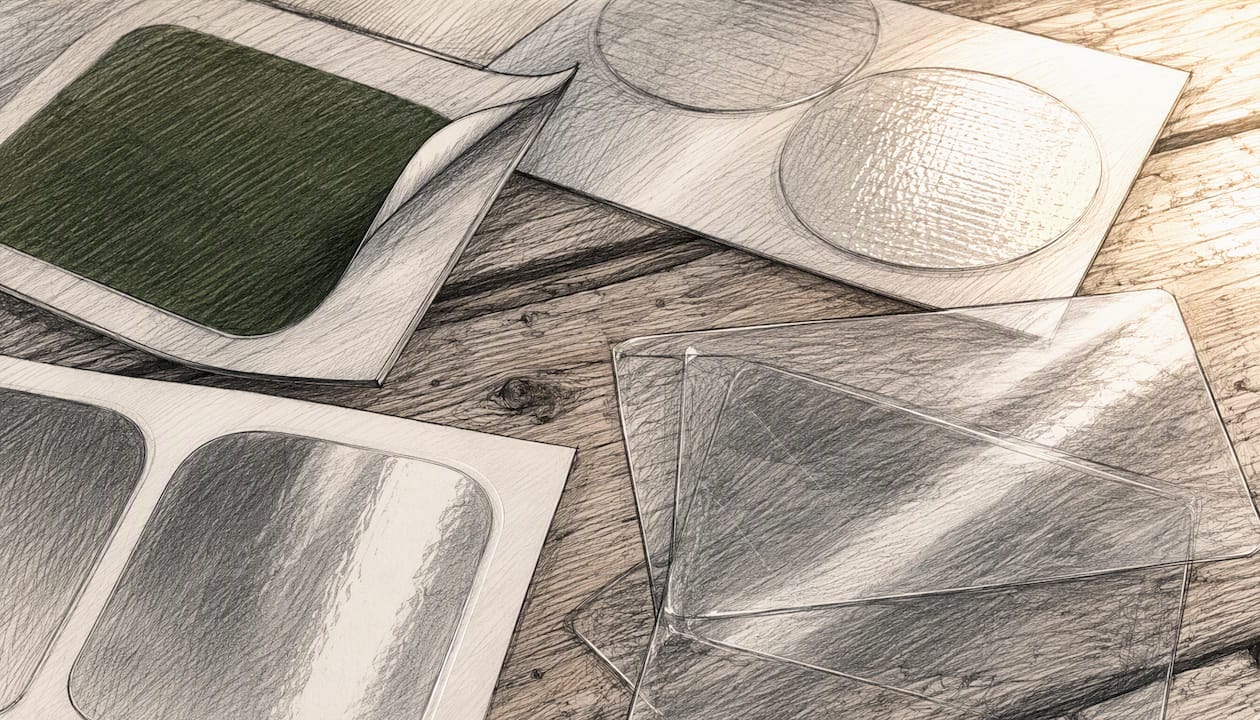
Laminates do the heavy lifting for ink protection. A gloss or matte overlaminate film bonded over the printed surface seals the ink and adds scratch resistance. UV laminates go further, blocking ultraviolet light to prevent fade. Overprint varnishes (OPV) are a lighter alternative but offer less physical protection than a full laminate film. Lamination significantly improves water resistance, but it doesn't fix weak adhesive, poor surface prep, or exposed paper edges.
Adhesives are often overlooked. Permanent pressure-sensitive adhesives (PSAs) rated for outdoor or low-surface-energy applications hold through temperature cycles and moisture. Removable adhesives are fine for dry indoor use but tend to lift in wet conditions.
Die-cut edges are the final variable. When a sticker is cut to shape, the laminate edge is exposed. Water can enter at that seam, especially on curved surfaces like bottles. Some manufacturers apply edge sealing or use a slightly oversized laminate to reduce this risk.
"A sticker's edges and adhesive are common failure points. Laminate protects the face but not edge lift; a well-pressed edge and appropriate adhesive are as important as the face material." — Print Uniforms
How long do waterproof stickers actually last?
Lifespan depends heavily on where the sticker lives and what it's exposed to. A rough guide by use case:
- Indoor use (dry conditions): Several years, often the life of the surface itself
- Water bottles and coolers (handwashed): 1–3 years with quality vinyl and laminate
- Outdoor signage (shaded): 2–5 years with cast vinyl and UV laminate
- Outdoor signage (direct sun): 1–3 years without UV laminate; 3–7 years with it
- Marine or saltwater exposure: 1–2 years for standard vinyl; longer with marine-grade films
The factors that shorten life most quickly:
- Continuous UV exposure without a UV-blocking laminate
- Repeated dishwasher cycles (heat + detergent combination)
- Salt, chemicals, or solvents in the environment
- Poor surface prep at application (oils, dust, or moisture under the sticker)
- Removable adhesive used in a permanent wet application
- Thin or no laminate on a high-abrasion surface
High-quality vinyl stickers with proper lamination handle rain, spills, and handwashing well, but repeated dishwasher cycles or prolonged submersion typically require specialty marine-grade films and adhesives. The honest answer for most buyers: a well-made laminated vinyl sticker on a water bottle will survive handwashing for years, but the dishwasher will shorten that life significantly unless the seller has tested for it specifically.
How to apply waterproof stickers and keep them lasting longer
Waterproof stickers perform best on smooth, clean, non-porous surfaces: glass, metal, hard plastic, and painted surfaces in good condition. Textured, flexible, or porous surfaces (fabric, rough wood, silicone) reduce adhesion and accelerate edge lift.
Application steps:
- Clean the surface with isopropyl alcohol and let it dry completely. Oils and residue are the top cause of early adhesion failure.
- Peel the backing slowly at a low angle to avoid stretching the sticker.
- Position before committing, then press from the center outward to push air bubbles to the edges.
- Press the edges firmly with a credit card or squeegee, paying extra attention to corners and die-cut curves.
- Allow 24 hours before any water exposure. For submersion (water bottles, outdoor gear), wait 48 hours.
Care tips:
- Handwash items with stickers using mild soap and cool water. Avoid scrubbing directly over the sticker.
- Skip the dishwasher unless the seller has explicitly tested and rated the sticker for dishwasher cycles, including the detergent type and heated-dry setting.
- If an edge starts to lift, press it back down with a fingernail or apply a small amount of clear adhesive sealant.
Pro Tip: If you're applying a sticker to a curved surface like a water bottle, warm the sticker slightly with a hair dryer on low heat. It makes the vinyl more pliable and reduces the chance of edge bubbling.
For wet-environment accessories that pair with waterproof stickers, waterproof pouches for water activities are worth considering when the gear itself needs protection beyond the sticker.
How to verify a seller's "waterproof" claim before buying
Ask for material specs, laminate details, ink type, adhesive spec, and any test results. A seller who can provide all five is worth trusting. One who responds with "it's waterproof, don't worry" is not.
Buyer checklist:
- What is the face material? (Cast vinyl, calendared vinyl, BOPP, PET, or paper?)
- Is the sticker laminated? What type of laminate? (Gloss, matte, UV?)
- What ink or printing system was used? (Solvent, eco-solvent, UV-curable, pigment, dye?)
- What adhesive is used, and what surfaces and temperatures is it rated for?
- Is there an outdoor-life rating in years?
- Has the sticker been tested for dishwasher cycles? If so: top rack or bottom, how many cycles, what detergent type, and was heated dry included?
- Is there a saltwater or immersion test result available?
Simple tests to request or run yourself:
- Ask for a sample and submerge it in water for 30 minutes. Check for edge lift, ink bleed, or surface bubbling.
- Run a sample through one dishwasher cycle on the top rack with standard detergent and heated dry. Inspect the edges and adhesion.
- Rub the printed surface firmly with a damp cloth 20 times. Any ink transfer means the laminate is thin or absent.
Dishwasher-safe claims vary widely; professional printers often specify the test conditions including top-rack placement, number of cycles, detergent type, and heated-dry settings. If a seller can't give you those parameters, treat the claim as unverified.
What Sincerelyskye recommends for most waterproof sticker needs
For most craft buyers, laminated vinyl is the right answer. It handles water bottles, tumblers, outdoor gear, and everyday wet conditions without requiring specialty materials or industrial adhesives. The Sincerelyskye logo sticker uses a vinyl face with a protective finish designed for real-world use, not just shelf display.
The recommendation from the Sincerelyskye side: if the sticker is going on a water bottle or tumbler you handwash, a laminated vinyl sticker with a permanent adhesive is the practical sweet spot. If it's going in the dishwasher, ask specifically about dishwasher testing before you buy anything, from anyone.
Pro Tip: For craft stickers you're selling or gifting, always tell the recipient the care instructions. Even the best laminated vinyl sticker will outlast one that goes through a dishwasher because the buyer didn't know to handwash it.
The spec details most buyers skip
There's a gap between what "waterproof" sounds like and what it actually delivers, and it shows up most clearly when a sticker fails on a water bottle after three months. The face material was fine. The ink was fine. The laminate was thin, the edges weren't pressed, and the adhesive wasn't rated for repeated wet-dry cycles. The sticker was technically waterproof and practically useless.
The crafting community tends to trust labels more than specs, which is understandable. Most buyers aren't materials scientists. But the two questions that catch most bad purchases are simple: "Is it laminated?" and "What's the adhesive rated for?" Those two answers tell you more than any marketing claim on the product page.
What I'd push back on is the idea that dishwasher safe is just a stronger version of waterproof. It's a completely different test. Heat-dry cycles and detergent chemistry attack adhesives in ways that rain and handwashing never do. A sticker that survives years on an outdoor sign can peel off a mug after two dishwasher runs. They're not on the same spectrum; they're different problems with different solutions.
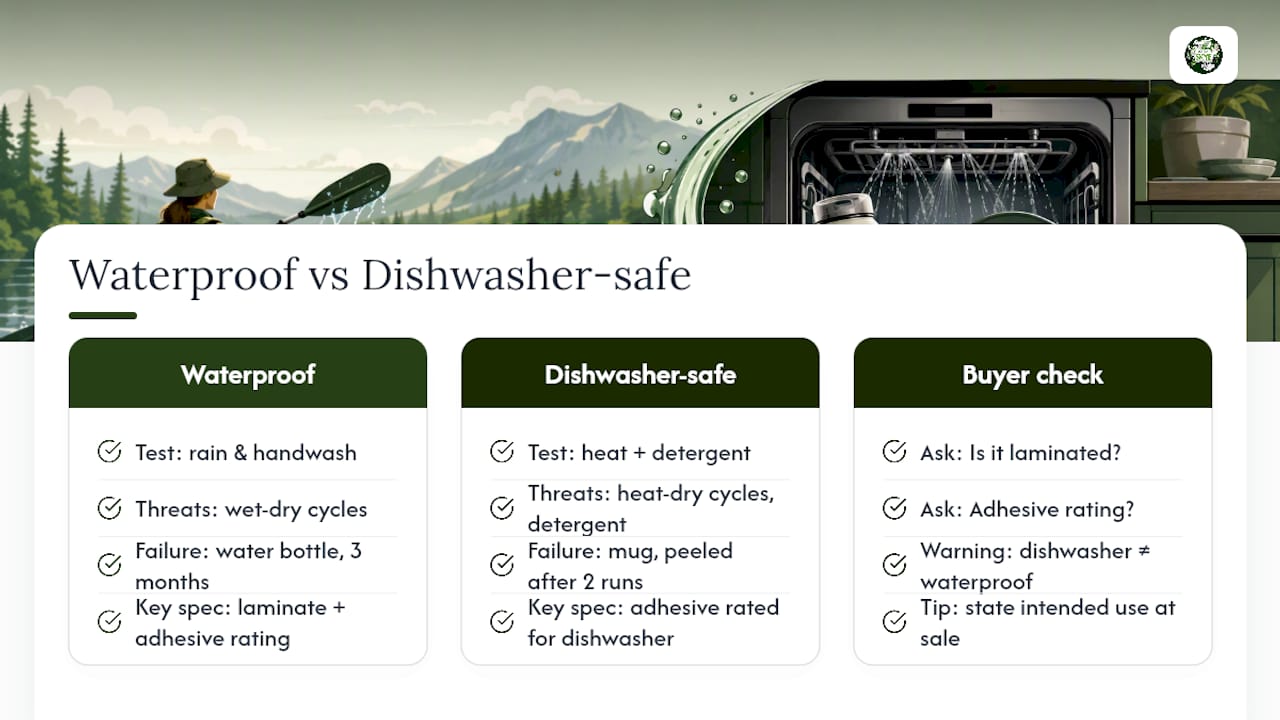
For crafters putting stickers on gifts, tumblers, or anything that will live in someone's kitchen, that distinction is the one worth explaining at the point of sale. It's not a caveat. It's the difference between a gift that lasts and one that doesn't.
Sincerelyskye's waterproof stickers for crafters and makers
Sincerelyskye makes laminated vinyl stickers built for the way crafters actually use them: on water bottles, tote bags, laptops, and outdoor gear that sees real life. The designs are whimsical and craft-inspired, and the construction is meant to hold up to handwashing and everyday wet conditions without the image fading or the edges lifting.
If you're looking for a sticker that celebrates your craft life and actually survives it, the Sincerelyskye gear collection is the place to start. For a specific look at the brand's sticker offering, the logo sticker is a good example of the finish and construction the brand uses. Custom or personalized options are available; reach out through the shop for special requirements.
Useful sources
- “Waterproof” vs “Weatherproof” vs “Dishwasher Safe” Stickers: What Those Claims Actually Mean - The Print Reviewer
- What Makes a Sticker Waterproof? - Print Uniforms
- Are Vinyl Stickers Waterproof? What You Need to Know - Apex Workwear
- Waterproof VS Water-Resistant Sticker Paper Explained For Beginners - Royal Elements
- Are vinyl stickers waterproof - iTech Packaging